Showing posts with label Bangladesh. Show all posts

Saturday, October 2, 2021

US to send more than 8 million COVID-19 vaccines to Philippines, Bangladesh

The United States announced Friday it is sending more than 8 million COVID-19 vaccine doses to the Philippines and Bangladesh in the latest wave of aid to a world still struggling to tame the pandemic.

Five shipments totalling 5,575,050 doses will go to the Philippines by next week, a White House official told AFP, speaking on condition of anonymity.

Another 2,508,480 doses will arrive early next week in Bangladesh, the official said.

The vaccines— all Pfizer-BioNTech— are being donated through the World Health Organization's COVAX program.

The "administration understands that putting an end to this pandemic requires eliminating it around the world," the official said, noting that US donations represent "the largest-ever purchase and donation of vaccines by a single country."

Hard-hit Bangladesh has already received millions of US vaccine doses, including another 2.5 million sent just last week.

According to AFP's database, only about 10 percent of Bangladesh's population has been fully vaccinated.

The impoverished country of about 170 million people, which neighbors India, has imposed some of the world's longest lockdowns in an attempt to stop the spread of COVID-19.

The Philippines has recorded more than 2.5 million infections, including over 38,000 deaths. Just over a quarter of the adult population has been fully vaccinated amid a delayed and slow vaccination rollout.

Officials warn the economy could take more than a decade to recover from the pandemic impact, which has thrown millions out of work.

Nearly 70 percent of the economy, including 23.3 million workers, remained under "heightened quarantine" restrictions, Economic Planning Secretary Karl Kendrick Chua said Thursday.

At his recent address to the United Nations, Philippine President Rodrigo Duterte scored wealthy nations for "hoarding" vaccines while the supply still came in trickles to poor nations. 

Agence France-Presse

Thursday, February 25, 2021

Bangladesh vaccinates sex workers at largest brothel

Bangladesh has begun administering coronavirus vaccines to sex workers from the country's largest brothel, a vast warren of shacks home to around 1,900 prostitutes.

The South Asian nation has so far vaccinated nearly 3 million people aged 40 or above with the AstraZeneca jab, but has scrapped the age restriction for sex workers at the town of Daulatdia in the country's west.

"At least 100 sex workers have already got the anti-Covid-19 jabs," Asif Mahmud, health chief in Daulatdia, told AFP.

"It is very necessary to vaccinate the sex workers... Thousands of people visit the brothel every day and the sex workers at the massive brothel are most vulnerable to the virus."

The country has focused on inoculating the elderly, frontline health workers and security forces since its vaccination drive launched early this month, but plans to eventually cover about 80 percent of the population.

The first sex workers from the brothel to receive the jab travelled to a clinic five kilometres (three miles) away, but Mahmud said authorities were also planning a dedicated vaccine centre inside the brothel.

Mohammad Ibrahim, chief doctor in Daulatdia, said "multiple awareness campaigns" were being conducted to encourage more people to get the jab.

Beauty, 40, who goes by one name, said she was initially hesitant as she had heard rumours that people died after receiving the shot.

"But the health officials reassured us. Now we understand it is important as we meet many people every day," she said.

Bangladesh is one of the few Muslim nations where prostitution is legal for women aged over 18, and at least 11 brothels are operational across the country of 168 million.

Beauty said vaccination would improve their incomes as many clients were worried about coronavirus and had been avoiding the congested brothel, which sits near a busy train station.

In March authorities restricted visits to all brothels when they imposed a month-long nationwide lockdown.

This badly hit the livelihoods of many sex workers and their families, forcing some to rely on food and cash handouts. Many left the brothel to work on the streets, community leaders said.

Jhumur Begum, who heads the main association of sex workers at Daulatdia, said vaccination would help them get back on their feet.

"It will drive out the overwhelming fear that you will get the virus if you visit Daulatdia. There were also fears that any outbreak would be very deadly here," Begum said.

Bangladesh is buying about 30 million AstraZeneca vaccine doses from the Serum Institute of India and will receive another 68 million from the Covax initiative, a global effort to encourage equitable distribution for poor nations.

More than 8,300 people have died of the virus in the country while nearly 545,000 had been infected as of Wednesday.

Agence France-Presse

Wednesday, April 1, 2020

Garment exports giant Bangladesh faces $6 billion hit due to COVID-19


DHAKA -- Bangladesh, the second-largest apparel producer after China, is set to lose roughly $6 billion in export revenue this financial year amid cancellations from some of the world's largest brands and retailers, 2 major industry bodies said on Tuesday.

The two groups, which represent the vast majority of the readymade garment and knitwear manufacturers in the country, said cancellations were increasing daily amid coronavirus-driven lockdowns globally, and these risked jeopardizing millions of jobs in the poor South Asian nation.

Low wages have helped Bangladesh build its garment industry, with some 4,000 factories employing 4 million workers.

Garment exports accounted for $34.12 billion, or 84 percent of the country's overall exports of $40.53 billion, in the fiscal year ended June 30, 2019.

"We've lost more than $3 billion due to the crisis. All our orders until July have been cancelled or suspended," Mohammad Hatem, vice president of Bangladesh Knitwear Manufacturers and Exporters Association (BKMEA), said.

"Suspended orders will eventually get cancelled. All these orders were placed for summer and it takes three months to get these delivered. If they are not taking supplies now they will not take it when the summer is over," said Hatem, adding buyers had adopted a wait and watch policy, and are refraining from placing new orders.

"Many factories will be closed if this persists," he added.

One industry source, who asked not to be named as the order books are confidential, said Gap, Zara, and Primark were among the brands that had cancelled orders.

Gap and Zara did not immediately respond to emails seeking comment. Primark confirmed the step.

All Primark stores across the world are closed and the brand has been losing sales of $807.82 million a month, Primark said in a statement.

"We have large quantities of existing stock in our stores, our depots and in transit, that is paid for", the statement said. "If we had not taken this action, we would be taking delivery of stock that we simply could not sell".

Readymade garment makers face a similar hit, warned Rubana Huq, the president of the Bangladesh Garment Manufacturers and Exporters Association (BGMEA).

Huq said some 1,048 factories that were part of BGMEA had reported that orders for over 900 million garments worth $2.9 billion had already been cancelled or were being held up.

Huq said the order cancellations could affect some 2 million workers in the readymade garments segment.

Prime Minister Sheikh Hasina recently unveiled a $588 million package for the country's crucial export sector, asking companies to put the money towards paying workers.

"This is not enough. The government should come up with more stimulus to save the country's biggest export sector," said Rezwan Selim, a director of BGMEA.

Siddiqur Rahman, a top exporter who supplies H&M, and Walmart among others, said the situation was dire.

"We're facing an unprecedented time," he said. "No one knows how long this is going to take. We're trying hard not to shut down our factories. But how long can we hold out?"

source: news.abs-cbn.com

Tuesday, November 12, 2019

16 dead as trains collide in Bangladesh


DHAKA, Bangladesh - Two packed trains rammed into each other in Bangladesh on Tuesday, killing at least 16 people and injuring nearly 60 others, police said.

Three coaches were sent crashing off the tracks at Mondobhag station in the town of Kasba when a Dhaka-bound train and a locomotive bound for Chittagong collided.

"At least 16 people have been killed. And another 58 were injured. We have sent the injured to different hospitals in the region," local police chief Anisur Rahman told AFP.

Cranes and other lifting gear were brought in to rescue trapped passengers, many of whom were asleep when the early morning crash took place.

"There was a loud noise, then I saw the train was completely ripped apart," one injured passenger told Somoy TV.

"All the people around me were crying. There was blood everywhere. Some people had broken hands and legs," another told the broadcaster. 

"My son was with me. I still don't know what happened to him," the man added.

Hayat ud Doula Khan, a government official in the district, said the Dhaka-bound Turna Nishitha train, hit the Chittagong-bound Udayan Express at about 3:00 am (2100 GMT Monday) as the Udayan was about to go through Mondobhog station.

Khan told AFP that the Turna Nishitha should have waited outside the station to let the other train pass and that an investigation had been started. A Bangladesh railway official told reporters faulty signals could be to blame.

"Three coaches were badly mangled and the victims are from these coaches," Khan said, adding that train services out of Dhaka had been halted because of the accident.

Train accidents are common in Bangladesh and are often caused by poor signaling or other rundown infrastructure.

According to the Shipping and Communication Reporters Forum (SCRF), a private media research group, between January 1 and June 30 this year, at least 202 rail accidents took place in the South Asian country of 168 million people where some of the track is a century old.

In June, a train plunged into a canal after the bridge it was crossing gave way. Five people were killed and 100 injured.

The SCRF said pedestrians using mobile phones while crossing tracks, negligence by railway employees and poor maintenance of lines and bridges were the main cause of crashes.

source: news.abs-cbn.com

Sunday, November 10, 2019

Cyclone Bulbul kills at least 2 as Bangladesh, India evacuate hundreds of thousands


MOUSOUNI ISLAND, India - Cyclone Bulbul hit India on Saturday, leaving at least two dead as authorities in the country and in neighboring Bangladesh ordered hundreds of thousands of people to get out of the path of the storm as it gained power.

The eye of the storm, packing winds of up to 120 kilometers (75 miles) per hour, was expected to hit the Bay of Bengal coast late Saturday near the Bangladesh-India frontier.

Airports and ports were shut down and the deaths were reported before the full force of the cyclone had hit. One person was killed by an uprooted tree in Kolkata and another by a wall that collapsed under the force of the winds in Odisha state, authorities said.

More than 60,000 people were moved away from the coast on the Indian side of the border while the Bangladesh government said 400,000 were evacuated.

Bangladeshi troops were sent to some villages, while about 55,000 volunteers went door-to-door and making loudspeaker announcements in the streets to get people away from the danger zone in villages, many of which were below sea level.

A storm surge up to two meters (seven feet) high was predicted along the coast, Bangladesh's Meteorological Department said.

About 1,500 tourists were stranded on the southern island of Saint Martin after boat services were suspended due to bad weather.

Bangladesh's two biggest ports, Mongla and Chittagong, were closed because of the storm, and flights into Chittagong airport were halted.


Flights suspended

In India, flights in and out of Kolkata airport were suspended for 12 hours because of the storm.

On the West Bengal island of Mousouni, which lies in the path of the storm, frightened residents took shelter in schools and government buildings because they had not been able to escape.

Military planes and ships have been put on standby to help in emergencies, Indian authorities said.

Bulbul was expected to hit the coast at the Sundarbans, the world's largest mangrove forest, which straddles Bangladesh and part of eastern India, and is home to endangered species including the Bengal tiger.

Bangladesh's low-lying coast, home to 30 million people, is regularly battered by cyclones that leave a trail of destruction.

Hundreds of thousands of people have been killed in cyclones in recent decades.

While the frequency and intensity have increased, partly due to climate change, the death tolls have come down because of faster evacuations and the building of 4,000 cyclone shelters along the coast.

In November 2007, Cyclone Sidr killed more than 3,000 people. In May this year, Fani became the most powerful storm to hit the country in five years, but the death toll was about 12.

source: news.abs-cbn.com

Saturday, November 9, 2019

Bangladesh evacuates 100,000 as Cyclone Bulbul approaches


DHAKA, Bangladesh - Bangladesh authorities have evacuated around 100,000 people from the country's low-lying coastal villages and islands, with Cyclone Bulbul set to slam into the country later on Saturday, officials said.

The Meteorological Department has asked local authorities and two ports to raise their highest alert, as the cyclone is expected to unleash a storm surge as high as two meters in coastal districts.

Bulbul, packing a maximum wind speed of 120 kilometers per hour, is on course to make landfall near the Sundarbans, the world's largest mangrove forest, which straddles Bangladesh and part of eastern India and is home to the endangered Bengal tigers.

The cyclone is expected to hit the Bangladesh coast at around 8 p.m. (1400 GMT), disaster management secretary Shah Kamal told AFP, adding there are plans to evacuate some 1.5 million people before that.

Authorities have suspended a nationwide school test, cancelled the holidays of officials posted in coastal districts and called off a traditional fair that draws tens of thousands of people in the Sundarbans.

Operations at the country's two major ports -- Mongla and Chittagong -- have been suspended, Kamal said.

Some 55,000 volunteers have been mobilized to go door to door and alert people about the storm.

Bangladesh's low-lying coast, home to 30 million people, is regularly battered by powerful cyclones that leave a trail of devastation in their wake.

Hundreds of thousands of people have been killed over the last few decades in cyclones, whose frequency and intensity have increased.

Bangladesh has, however, improved its preparedness in recent years, cutting the number casualties since Cyclone Sidr killed more than 3,000 people in 2007.

In May this year, Fani became the most powerful storm to hit the country in five years, but just over a dozen people were killed.

source: news.abs-cbn.com

Thursday, October 24, 2019

16 sentenced to death for burning alive Bangladesh teen


FENI, Bangladesh – Sixteen people were sentenced to death Thursday for burning alive a Bangladeshi teenager who refused to withdraw sexual assault charges against her head teacher.

The case highlights what activists say is a culture of impunity over sexual violence in the South Asian country of 168 million people, as well as abuse rife in around 20,000 seminaries that educate mostly poor and rural students.

Nusrat Jahan Rafi was doused in kerosene and set on fire on April 6 after she made a sexual harassment complaint against the principal of her rural Islamic seminary.

The head teacher, who a court in the southern coastal town of Feni found had ordered the brutal killing from jail after being arrested over the harassment claim, was among those sentenced to death.

Others included activists from the ruling Awami League party and some students -- including two females -- who either participated in the killing or guarded the gates of the seminary while it took place.

"The verdict proves that nobody will get away with murder in Bangladesh. We have the rule of law," prosecutor Hafez Ahmed told reporters after the verdict in a crowded courtroom.

Rafi was lured to the rooftop of the seminary in Sonagazi where her attackers pressed her to withdraw the complaint she had filed with police.

When she refused, she was tied up, doused in kerosene and set on fire.

She suffered burns to 80 percent of her body and died in hospital four days later.

Her death triggered widespread horror across the nation, with protesters in the capital Dhaka staging days of demonstrations seeking "exemplary punishment" for the killers.

The murder put pressure on Prime Minister Sheikh Hasina to do more to protect women, with her government ordering some 27,000 schools to set up committees to prevent sexual violence.

'NOT A BIG DEAL'

Rafi had gone to police in late March to report the sexual harassment, and a leaked video shows the local station chief registering her complaint but dismissing it as "not a big deal".

Police said the attackers' plan had been to pass off her death as suicide, but this failed after Rafi managed to stagger down the stairs while still engulfed in flames.

Activists say many of the women and children who report sexual violence in Bangladesh often suffer a backlash, and that successful prosecutions are rare.

Rafi's case was fast-tracked, with the hearing taking only 62 days at a special tribunal hearing cases of violence against women and children.

Maleka Banu, head of a woman's rights group, told AFP: "It is an exemplary punishment. We hope it will send a serious message to the perpetrators and collaborators of sexual violence."

She said she hoped the verdict would work as a deterrent and would bring down "alarming rise" in sexual violence in the country.

Since the arrest of the principal, at least five more madrasa teachers have been held on charges of rape and sexual assault of their students.

The head of the Mahila Parishad, another women's rights group, gave a "guarded welcome" at the quick conclusion of the case, but said more needed to be done to ensure increased convictions for sexual harassment and rape cases.

According to that group, there were 731 incidents of sexual violence reported in the first six months of the year, including 592 rapes, 113 gang rapes and 26 women who were killed after being sexually assaulted.

Researcher Rezaur Rahman Lenin said on average more than 200 people are sentenced to death each year in Bangladesh, and as of May around 1,500 people were on death row

The number of executions carried out is less than 10 a year.

Defense lawyers said they would appeal against Thursday's verdict in the high court.

source: news.abs-cbn.com

Thursday, August 29, 2019

Bangladeshis reveal 'rampant' rapes in Islamic schools


DHAKA - Former Bangladeshi students are turning to social media to detail allegations of "rampant" sex abuse at the hands of teachers and older pupils in Islamic schools, breaking their silence on a taboo topic in the conservative country.

Child abuse in madrasas has long gone unreported in Bangladesh, a Muslim-majority nation where hardline Islamist groups draw their support from the tens of thousands of schools across the nation of 169 million people.

But in the wake of a brutal murder of a teenage girl who was burnt to death in April after accusing her headteacher of sexual assault, such incidents have been subject to national scrutiny and debate for the first time.

In July alone, at least five madrasa teachers have been arrested on rape charges against boys and girls under their care.

Several senior students were also held by police over the rape and beheading of an 11-year-old orphan, while a Dhaka cleric and seminary teacher was charged with sexually assaulting a dozen boys aged between 12 and 19.

The accusations reveal how students from poorer and rural backgrounds, whose parents send them to madrasas as they are more affordable than secular schools, are disproportionately affected by the abuse.

Rights activists said the assaults -- which range from violent rapes to forcible kissing -- are so pervasive that the cases reported in the media are just the tip of the iceberg.

"For years these crimes eluded spotlight due to sensitivity of the subject," Abdus Shahid, the head of child rights' group Bangladesh Shishu Odhikar Forum, told AFP.

"Devout Muslims send children to madrasas, but they don't speak up about these crimes as they feel it would harm these key religious institutions."

'WIDESPREAD AND RAMPANT'

Hojaifa al Mamduh, who studied in three madrasas in the capital Dhaka, published a series of posts on Facebook in July detailing the abuses endured by students including himself.

The assaults were "so widespread in the madrasas, every student who has studied there knows about it", Al Mamduh, now a journalism student at a Dhaka University, told AFP.

"Many madrasa teachers I know consider sex with children a lesser crime than consensual extramarital sex with women. Since they live in the same dormitories, the perpetrators can easily hide their crimes and put pressure on their poor students to keep mum."

The 23-year-old's posts generated heated debate in the country, and he was personally threatened.

He was accused of being "an agent of Jews and Christians" and smearing the "sacred image" of a madrasa by one social media user.

Another reminded him of the fate of Avijit Roy, a top Bangladeshi atheist blogger and writer who was hacked to death by Islamist extremists in 2015.

But his posts encouraged others to share their own experiences of alleged sex crimes.

Mostakimbillah Masum, who published his story on a feminist website, said he was "first raped by an elder student in my madrasa when I was just seven".

The 25-year-old told AFP that another one of his rapists was "a teacher who made me unconscious and raped me. It traumatised me permanently".

"Dozens of madrasa students I know were either raped or witnessed rapes and sexual assaults of their fellow students," he added. "It is so rampant almost every madrasa has a fair share of such stories."

CULTURE OF IMPUNITY 

Madrasa teachers have strongly denied the allegations, calling them "negative propaganda".

Mahfuzul Haq, a principal of a madrasa in Mohammadpur where Al Mamduh studied, told AFP "one or two isolated incidents can happen" as there were 20,000 madrasas in the South Asian nation.

"Those who don't like to study in madrasas are spreading these stories," he added.

A spokesman for hardline Islamist group Hefazat-e-Islami, which represents a coalition of thousands of madrasas, said his organisation told a recent conference of 1,200 principals to take "tough stand against any sex crimes".

However, there has been growing acknowledgment of the alleged offences.

Pro-Islamic website Fateh24.com, viewed as a voice for the madrasas, pointed out in a report that children were at risk in smaller seminaries run by just one or two teachers and that had no oversight from governing bodies.

Editor Iftekhar Jamil, a former madrasa student and teacher, added that the cases were "not isolated" incidents and called for closed-circuit cameras to be installed in students' sleeping quarters.

"Instead of looking for conspiracies, these madrasas must take up responsibility and adopt an action plan to tackle these crimes," he told AFP.

sa/grk/aph/rbu

source: news.abs-cbn.com

Tuesday, August 13, 2019

40 dead in Bangladesh's worst-ever dengue outbreak


DHAKA - At least 40 people have died in Bangladesh's worst-ever outbreak of dengue, officials said Tuesday, as overburdened hospitals struggled to treat thousands of patients.

Outbreaks of the mosquito-borne viral infection, which causes flu-like symptoms but can be deadly if it develops into a hemorrhagic fever, usually occur in the South Asian nation during the monsoon season between June and September. But this year, the disease has reached epidemic proportions.

More than 44,000 people have been admitted to hospitals with the illness since January, including some 2,100 on Monday alone, said health ministry official Ayesha Akhter. 

"We have confirmed 40 dengue-related casualties so far to Monday," she told AFP.

Local media put the number much higher, reporting that the death toll passed 100 last week.

The week-long holiday marking the Muslim festival of Eid-al-Adha has seen hundreds of thousands of people leaving Bangladeshi cities to return to their family homes in the countryside, raising concerns that the disease will spread further. 

The country's health minister said the outbreak was "gradually reducing" while inaugurating an emergency dengue ward at a public hospital in Dhaka this week.

For the first time on record, holidays for all public health workers have been canceled to help respond to the crisis, said health ministry director-general Abul Kalam Azad.

"It is getting very tough to cope up with the amount of work pressure," one medical officer told AFP.

source: news.abs-cbn.com

Thursday, May 9, 2019

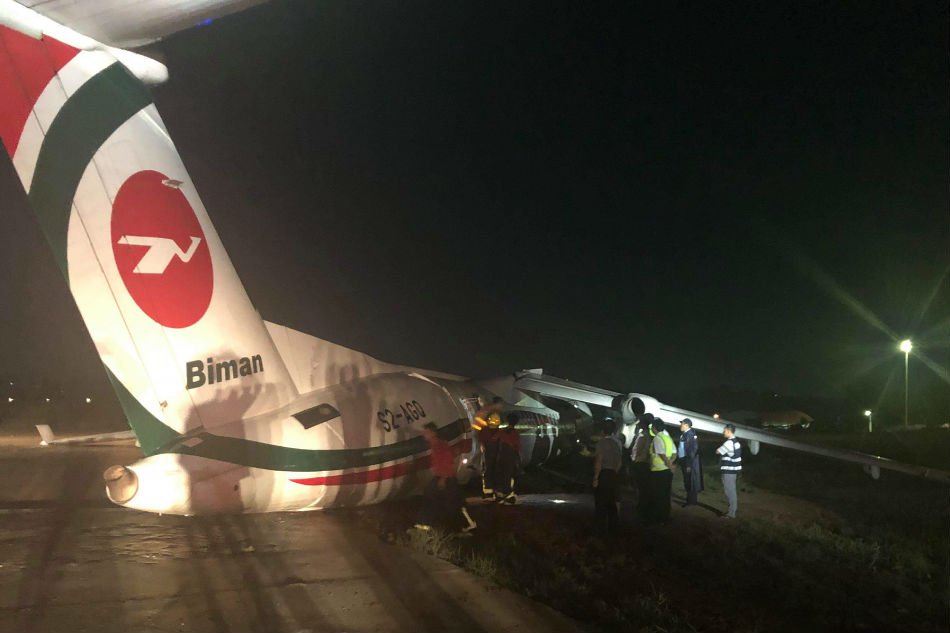
17 hurt as plane skids off Myanmar runway


YANGON, Myanmar - A Biman Bangladesh Airlines plane skidded off the runway when it landed in bad weather at Yangon's international airport on Wednesday evening, injuring at least 17 people, officials said.

The Bombardier Dash 8 aircraft was carrying 29 passengers and 4 crew when it bounced while landing during heavy winds in Myanmar's commercial capital, Bangladesh's ambassador said. The plane was severely damaged.

The 17 who sustained mostly minor injuries were admitted to a local hospital, Manjurul Karim Khan Chowdhury told Reuters.

"The main reason, the pilot told me, was the weather – crosswinds," he said. "When he was trying to land... suddenly the aircraft jumped, went up and went down heavily."

A photo published by the Myanmar Times showed the plane halfway off the runway with its fuselage apparently broken.

Shakil Miraj, general manager for Biman Bangladesh, also blamed bad weather for the crash.

The airline flies between Yangon and Bangladesh's capital Dhaka 4 days a week.

A spokesman for Myanmar's Department of Civil Aviation declined to comment, saying the department had not received a report of the incident from the ground.

source: news.abs-cbn.com

Sunday, May 5, 2019

Praise for India's response to devastating cyclone


NEW DELHI -- UN and other experts Saturday praised India for its early warning systems and rapid evacuation of more than 1 million people, which they said helped minimize loss of life from a deadly cyclone that battered its eastern coast.

Cyclone Fani, one of the biggest to hit India in years, tore into Odisha Friday, leaving a trail of devastation across the coastal state of 46 million people before swinging towards Bangladesh. 

In 1999 the same state was hit by a devastating 30-hour super-cyclone that saw a storm surge sweep 20 kilometers inland. Unprepared for the scale of the disaster, authorities struggled to evacuate the stricken population and some 10,000 people were killed. 

This time, improved forecasting models, public awareness campaigns and well-drilled evacuation plans -- backed up by an army of responders and volunteers -- has seen Odisha's inhabitants spared the worst of Fani's fury.

Only 12 people have been killed by the cyclone in India -- which escaped being hit by a major storm surge -- and at least 160 injured, local media reported. 

As soon as it became clear this week that Fani was on course to hit Odisha, emergency teams began the mammoth task of evacuating those living in low-lying regions, moving 1.2 million residents away from danger areas and in to temporary shelters.

Alerts asking residents to stay indoors and follow the dos and don'ts were issued repeatedly on TV and radio, and broadcast through loudspeakers in public places.

The UN Office for Disaster Risk Reduction (UNDRR) praised the government's "effective" evacuation, saying it had "saved many lives".

NEW WEATHER MODELS 

The state government in Odisha along with national disaster response teams and volunteers have worked in tandem to carry out evacuations and set up safe shelters.

Workers have been equipped with satellite phones and inflatable boats along with food and medicines to distribute in the storm's aftermath.

Some 7,000 kitchens catering to 9,000 shelters have been set up, thanks to an army of 45,000 volunteers. 

Emergency workers are now focusing on restoring damaged infrastructure, including power and telecom lines, and clearing roads.

Mahesh Palawat, the vice president of meteorology at private forecaster Skymet, said the early warnings had been vital in allowing authorities to plan in advance.

"From April 25 onwards we (the Indian Meteorological Department and Skymet) had been monitoring the track and intensity of the cyclone continuously, what time it would make landfall and the probable points of landfall," Palawat told AFP.

Numerical models, adopted by the Indian Meteorological Department (IMD) in 2014 to supplement the more traditional statistical modelling, allowed forecasters to track Fani's progress and wind profiles in the upper atmosphere.

Denis McClean, a spokesperson for UNISDR, said "the almost pinpoint accuracy" of the early warnings from the IMD had enabled the authorities to "conduct a well-targeted evacuation plan."

Social media users also lauded the Indian authorities for averting a mass human disaster, despite the fact that a densely populated region was in the eye of the storm.

"Credit goes to #India authorities for their aggressive pre-impact response, including massive evacuations," wrote Josh Morgerman, a US-based cyclone expert.

source: news.abs-cbn.com

Wednesday, January 30, 2019

Bangladesh to sue RCBC over $81-M cyberheist


DHAKA - Bangladesh will file a lawsuit in a US court on Wednesday against Philippine bank Rizal Commercial Banking Corp (RCBC) over its role in one of the world's biggest cyber-heists, the Bangladesh central bank governor said.

In February 2016, unknown criminals used fraudulent orders on the SWIFT payments system to steal $81 million from the Bangladesh central bank account at the Federal Reserve Bank of New York. 

The money was sent to accounts at Manila-based RCBC and then vanished into the casino industry in the Philippines.

Fazle Kabir, governor of the Bangladesh Bank, said the lawsuit would be filed in the US District Court for the Southern District of New York.

"All necessary processes have been completed and Bangladesh signed an agreement Tuesday night with the New York Fed Bank to assist Bangladesh in handling this case," Kabir told reporters.

For its part, RCBC has previously said the cyber heist was an inside job and Bangladesh Bank was engaging in a cover-up by maligning it. 

On Wednesday, RCBC said in a statement it had engaged a top New York law firm to handle its defense.

"We welcome this complaint, as it is an opportunity for RCBC to put on record again that it was a victim of what was started in Bangladesh by still unnamed persons," the bank said.

This month a Philippine court found former RCBC branch manager Maia Deguito guilty on eight counts of money laundering in connection with the heist and sentenced her to a jail term ranging from 32 to 56 years. 

The Philippine central bank fined RCBC a record one billion pesos ($20 million) in 2016 for its failure to prevent the movement of the stolen money through the bank. 

A former treasurer of RCBC and five other workers at the branch where the cash was withdrawn face money laundering charges.

Just $15 million of the stolen money has been recovered from a Manila junket operator, a role that involves marketing casinos to VIPs.

source: news.abs-cbn.com

Sunday, August 5, 2018

Bangladesh shuts down mobile internet to tackle teen protests


DHAKA - Bangladesh authorities have shut down mobile internet across swathes of the country, officials and local media said Sunday, as the authorities try to quell massive student protests that have spiraled into violence.

For the last week students have brought parts of the capital Dhaka to a standstill with a protest against poor road safety after 2 teenagers were killed by a speeding bus.

On Saturday the protests took a violent turn in Dhaka's Jigatala neighborhood with more than 100 people injured. 

Witnesses said police fired rubber bullets and tear gas at demonstrators and that alleged pro-government activists attacked youngsters, including some of those rushing to nearby hospitals for treatment.

The country's highest circulated newspaper Prothom Alo said 3G and 4G internet services have been shut down for 24 hours since late Saturday, shortly after the violence broke out.

Social media has been filled with comments from Bangladeshis unable to access the internet via their phones, although wireless and wired networks appear to be unhindered.

Jahirul Haq, chairman of the Bangladesh Telecommunications Regulatory Commission (BTRC), told AFP they received a "decision" from the government. But he did not clarify what was the government order was. He said he would comment further on the situation later Sunday.

A senior telecoms official who asked for anonymity said: "The BTRC has slowed down the internet at the order of the government."

The move may be an attempt to try and limit the ability of students to mobilize or spread growing online outrage over how the government has handled the protests, hours after police and unidentified men wielding sticks and stones clashed with students. 

Images and photos of the attacks on students allegedly by the ruling party activists have flooded the social media, prompting renewed outrage.

Police denied they fired rubber bullets or tear gas at the protesters. However hospital staff said dozens of people had been injured, some seriously, sporting injuries consistent with rubber bullets.

The ruling Awami League party has also denied allegations its cadres beat students up. 

Bangladesh's transport sector is widely seen as corrupt, unregulated and dangerous, and as news of the teenagers' deaths spread rapidly on social media they became a catalyst for an outpouring of anger against the government.

The government of Prime Minister Sheikh Hasina has ruled Bangladesh since 2009, but in recent months it has been shaken by mass protests demanding an end to a decades-old system of discriminatory civil service recruitment. 

Several powerful ministers have pleaded with students to return to their classes, amid worries the unprecedented teen outrage could turn into widespread anti-government protests ahead of general elections due later this year.

But their pleas have had little effect.

source: news.abs-cbn.com

Wednesday, November 8, 2017

Nepal bank latest victim in heists targeting SWIFT system


KATHMANDU - A bank in Nepal is the latest victim in a string of cyber heists targeting the global SWIFT bank messaging system, though most of the stolen funds have been recovered, 2 officials involved in the investigation confirmed on Tuesday.

Hackers last month made about $4.4 million in fraudulent transfers from Kathmandu-based NIC Asia Bank to countries including Britain, China, Japan, Singapore and the United States when the bank was closed for annual festival holidays, according to Nepal media reports.

All but $580,000 of the funds were recovered after Nepal asked other nations to block release of the stolen money, Chinta Mani Shivakoti, deputy governor of the Central Nepal Rastra Bank (NRB), told Reuters.

Brussels-based SWIFT said last month that security controls instituted after last year's $81 million theft from Bangladesh's central bank helped thwart some recent hacking attempts, but it warned that cyber criminals continue to target SWIFT customers.

SWIFT or the Society for Worldwide Interbank Financial Telecommunication is a co-operative owned by its user banks. It declined to comment on the NIC Asia Bank hack, saying it does not discuss specific users.

Representatives with NIC Asia Bank, one of dozens of private banks in Nepal, were not available for comment.

The chief of Nepal's Central Investigation Bureau, Pushkar Karki, confirmed to Reuters that his agency was investigating the theft.

KPMG is also involved in the investigation, according to Nepali media reports. KPMG representatives could not immediately be reached for comment.

The central bank intends to release guidelines on how to thwart such incidents after investigations are completed, according to Shivakoti.

"The incident showed there are some weaknesses with the IT department of the bank," Shivakoti said.

SWIFT said in a statement on Tuesday that it offers assistance to banks when it learns of potential fraud cases, then shares relevant information with other clients on an anonymous basis.

"This preserves confidentiality, whilst assisting other SWIFT users to take appropriate measures to protect themselves," it said.

"We have no indication that our network and core messaging services have been compromised," SWIFT added.

source: news.abs-cbn.com

Friday, April 22, 2016

Bangladesh Bank exposed to hackers by cheap switches, no firewall: police


DHAKA -- Bangladesh's central bank was vulnerable to hackers because it did not have a firewall and used second-hand, $10 switches to network computers connected to the SWIFT global payment network, an investigator into one of the world's biggest cyber heists said.

The shortcomings made it easier for hackers to break into the Bangladesh Bank system earlier this year and attempt to siphon off nearly $1 billion using the bank's SWIFT credentials, said Mohammad Shah Alam, head of the Forensic Training Institute of the Bangladesh police's criminal investigation department.

"It could be difficult to hack if there was a firewall," Alam said in an interview.

The lack of sophisticated switches, which can cost several hundred dollars or more, also means it is difficult for investigators to figure out what the hackers did and where they might have been based, he added.

Experts in bank security said that the findings described by Alam were disturbing.

"You are talking about an organization that has access to billions of dollars and they are not taking even the most basic security precautions," said Jeff Wichman, a consultant with cyber firm Optiv.

Tom Kellermann, a former member of the World Bank security team, said that the security shortcomings described by Alam were "egregious," and that he believed there were "a handful" of central banks in developing countries that were equally insecure.

Kellermann, now chief executive of investment firm Strategic Cyber Ventures LLC, said that some banks fail to adequately protect their networks because they focus security budgets on physically defending their facilities.

POLICE BLAME BANK, SWIFT

Cyber criminals broke into Bangladesh Bank's system and in early February tried to make fraudulent transfers totalling $951 million from its account at the Federal Reserve Bank of New York.

Most of the payments were blocked, but $81 million was routed to accounts in the Philippines and diverted to casinos there. Most of those funds remain missing.

The police believe that both the bank and SWIFT should take the blame for the oversight, Alam said in an interview.

"It was their responsibility to point it out but we haven't found any evidence that they advised before the heist," he said, referring to SWIFT.

A spokeswoman for Brussels-based SWIFT declined comment.

SWIFT has previously said the attack was related to an internal operational issue at Bangladesh Bank and that SWIFT's core messaging services were not compromised.

A spokesman for Bangladesh Bank said SWIFT officials advised the bank to upgrade the switches only when their system engineers from Malaysia visited after the heist.

"There might have been a deficiency in the system in the SWIFT room," said the spokesman, Subhankar Saha, confirming that the switch was old and needed to be upgraded.

"Two (SWIFT) engineers came and visited the bank after the heist and suggested to upgrade the system," Saha said.

GLOBAL WHODUNIT

The heist's masterminds have yet to be identified.

Bangladesh police said earlier this week they had identified 20 foreigners involved in the heist but they appear to be people who received some of the payments, rather than those who initially stole the money.

Bangladesh Bank has about 5,000 computers used by officials in different departments, Alam said.

The SWIFT room is roughly 12 feet by 8 feet, a window-less office located on the eight floor of the bank's annex building in Dhaka. There are four servers and four monitors in the room.

All transactions from the previous day are automatically printed on a printer in the room.

The SWIFT facility should have been walled off from the rest of the network. That could have been done if the bank had used the more expensive, "managed" switches, which allow engineers to create separate networks, said Alam, whose institute includes a cyber-crime division.

Moreover, considering the importance of the room, the bank should have deployed staff to monitor activity round the clock, including weekends and holidays, he said.

source: www.abs-cbnnews.com

Tuesday, March 1, 2016

Report: Hackers steal $100-M from Bangladesh


Nearly P5 billion in illicit funds found its way into the country, laundered at the casino tables and some banks, and promptly spirited out of the Philippines.

Warren de Guzman spoke with regulators, who are saying the weaknesses in the Anti-Money Laundering Law are beginning to show. - The World Tonight, ANC, February 29, 2016

source: www.abs-cbnnews.com

Monday, June 25, 2012

Filipino nurses tapped by leading hospital in Bangladesh

MANILA, Philippines - A leading hospital in Bangladesh will be hiring Filipino nurses to work at their facility in the country’s capital, Dhaka, the Philippine Embassy in Dhaka reported.

Brig. Gen.(Retd) Shahidul Islam and Dr. Salahuddin Ahmed, Director of Operation and Administration, and Chief Coordinator for Development, respectively, of the United Hospital, informed Philippine Ambassador to Bangladesh Bahnarim A. Guinomla, at a courtesy call at the Embassy, that the recruitment of Filipino medical workers is in progress, especially the documentation requirements.

Dr. Ahmed visited the Philippines recently to start interviewing applicants in Manila.

Ambassador Guinomla described the move of the hospital as a ground-breaking development, as most Filipino nurses work in more developed markets; and that Bangladesh itself sends workers overseas.

The ambassador thanked both Brig. Gen. Islam and Dr. Ahmed for their confidence in the widely-proven skills and reliability of Filipino medical workers.

The hospital plans to assign the successful applicants to the so-called critical areas including emergencies and intensive care cases or the so-called Basic Life Support (BLS) work.

In a letter to Guinomla, Managing Director Faridur Rahman Khan described United Hospital as a multi-disciplinary hospital providing services to both local and foreign patients, especially those from the diplomatic area in Dhaka, since its inception in August 2006.

source: interaksyon.com