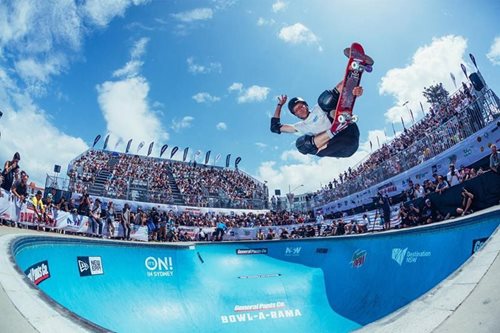
Showing posts with label Skateboarding. Show all posts

Wednesday, August 4, 2021

Japan's Yosozumi wins battle of the teens for Olympic skateboarding gold

TOKYO -- Japan's Sakura Yosozumi won the women's park competition to maintain the hosts' stranglehold on Olympic skateboarding on Wednesday and stop Kokona Hiraki and Sky Brown becoming the Games' youngest-ever gold medallists.

The 19-year-old carved up the Ariake Urban Sports Park with a flowing opening run in the final and her 60.09 points proved enough for victory ahead of teammate Hiraki, 12, and Brown, 13.

Despite missing the title Hiraki, who scored 59.04, becomes the youngest Olympic medalist since French rower Noel Vandernotte in 1936.

Brown, now Britain's youngest medalist, threatened to snatch a dramatic win with a flawless closing routine but her 56.47 was only good enough for bronze. 

"It was unbelievable," Brown said of her closing run. "Even right now it feels like a dream. It's insane. 

"I'm so happy and so thankful and so proud of every one of the other girls, too."

There was heartbreak for world number one Misugu Okamoto, who missed a medal when she fell on all three runs in the final to finish fourth.

Japan also snapped up the men's and women's street titles and they have bagged five of the nine medals so far as skateboarding makes its Olympic bow.

Skateboarding is one of four debut sports intended to reach new audiences and in an ultra-young field, only eight of the 20 competitors were out of their teens. The podium had a combined age of 44.

Both Brown, at 13 years and 28 days, and Hiraki (12 years and 343 days) were bidding to break an 85-year-old record to become the youngest champions in Olympic history.

They had a shot at bettering American diver Marjorie Gestring, who won 3m springboard gold aged 13 years and 268 days at the 1936 Games in Berlin.

For Brown, who is also Britain's youngest-ever Olympian, it completes a comeback just over a year after a horrific fall in training left her with skull fractures and a broken wrist and hand.

The accident would have ruled Brown, just 11 at the time, out of the 2020 Olympics if they had not been postponed for a year over the coronavirus pandemic.

"Everyone did amazing, everyone was doing so good, I'm so proud of everyone," she said on Wednesday, paying tribute to her friend Yosozumi.

"Just being on the podium with my really good friend is just insane."

Brown, born to a Japanese mother and a British father, opted to compete for Britain in 2019, saying the team offered a more relaxed approach.

Agence France-Presse

Sunday, August 11, 2019

Skateboarding does not need Olympic validation, says Tony Hawk


CHELLES, France -- Skateboarding does not need the prestige of Olympic status, and it could inadvertently harm the sport's counter-cultural standing, skateboarding great Tony Hawk said on Saturday.

Hawk was commenting on his sport's inclusion in the 2020 Olympic Games in Tokyo at the Vans Park Series France event in the Chelles suburb, near Paris.

"My only concern of skateboarding on the Olympic platform is that somehow that will inspire people to skate only for fame or fortune," said Hawk, who is also the inspiration for the popular Tony Hawk's Pro Skater video game series.

"Skateboarding has so much more to offer young people in terms of self-confidence, in terms of identity, in terms of setting their own challenges. And that is not competitive-based," the 51-year old American told Reuters.

The International Olympic Committee (IOC) unanimously supported bringing skateboarding to the Tokyo 2020 Games, but that does not guarantee future appearances for the sport.

Hawk went on to say that the Olympics needed skateboarding more than the other way round.

"Through my more prominent professional years, I wouldn't have cared if it was in the Olympics because we already had our own scene and skateboarding was far more fun and popular than most Olympic sports," said Hawk.

"At this point, I feel like they need our cool factor more than we need their validation."

The Chelles event highlighted the sport's popularity. Stands were packed, with many fans decked out in Vans gear with their skateboards in hand.

The competition is unlike most sports. Waiting for their 40-second run, skaters hung around the deck of the park, talking and shouting while their friends beside them enjoyed a beer or a snack from a food truck.

This uniqueness, Hawk added, born of the sport's creative, alternative spirit, should continue to attract potential skaters -- not its popularity or lucrativeness.

The International Olympic Committee has given skateboarding a provisional green-light for the Paris 2024 Games alongside surfing, climbing and breakdancing. The final decision will be made in late 2020, after the Tokyo Olympics.

Hawk, who turned pro in 1982 at the age of 14, did not enjoy the same level of acceptance at the time, but the counterculture aspect of the sport pushed him further.

"I'm really thankful that I got to grow up in a time when we had to prove ourselves, just through our own dedication and not a validation from some from higher source," he said.

source: news.abs-cbn.com

Wednesday, August 29, 2018

After Margielyn Didal gold, Cebu mayor vows to build skate park in city


Now that Margielyn Arda Didal has won a gold medal in the 2018 Asian Games, she no longer has to worry about being chased by the police while skateboarding in the streets of Cebu City.

Cebu City Mayor Tomas Osmeña promised to build a skating park for aspiring athletes to follow in Didal's footsteps.


In a Facebook post, Osmeña congratulated the 19-year-old Cebuana for her performance in the Games.

“Margielyn Didal of Lahug just won Gold in the (20)18 Asian Games in Indonesia. She also represented Cebu in the UK last May where she was the only competitor from Asia. Congratulations Margielyn!” he said. 

“Because the awareness raised by people like you, Cebu City will be building a skate park in the SRP. My sister is personally donating P5M to your cause.”

Didal previously lamented that most skateboarders have been subjected to discrimination, as they are considered a nuisance when they skate along the roads or sidewalks.

“Nag-ii-skate kami sa Cebu sa streets lang,” she said in an interview with ABS-CBN’s Dyan Castillejo. “Hinahabol kami ng pulis ng security ‘pag may nakikitang nagiiskate.”

“Minsan 'pag nasa mall pag may hawak na skate board bawal nang pumasok.” 

Osmeña said Didal will no longer worry about such things. In fact, he even invited her to help design the proposed skate park.

“As the expert, your input is of course welcome on the park’s design. Soon, people like you will finally have a place that is safe, free from traffic, and able to call your own,” he said.

Didal’s golden performance in the Games’ women’s street skate event netted her a total of windfall of P6 million in incentives from the government and private patrons.

The 19-year-old will use the bonus to make sure that parents won’t have to scrounge for money again.
“First of all gagamitin para sa family po,” said Didal. “Baka magtayo ng negosyo para sa family din. Para hindi na kelangang magwork ng mama at papa ko.”

Didal is the fourth among 5 children. Her father works as a carpenter while her mother sells street food in Lahug.

She left school after finishing Grade 7 to go through extensive training overseas. Didal had to sacrifice her studies to able to provide financial support to her family. 

source: news.abs-cbn.com

Monday, May 8, 2017

How skateboard legend Tony Hawk plans for the long road ahead


NEW YORK -- When most people hear the name Tony Hawk, they picture him whirling through a 900 on his skateboard at ESPN's X-Games, or on the cover of the iconic video game series, Tony Hawk's Pro Skater, which has collectively sold millions of copies.

But Hawk, 48, is also successful off a skateboard, working as an entrepreneur, philanthropist and investor. Over the past three decades, he has founded Birdhouse Skateboards, the Tony Hawk Foundation and invested in tech companies from DocuSign to Nest.

Hawk recently spoke with Reuters about the financial lessons he has learned over the years, from his days as a high-flying teenage skate champion to a father of teenagers today.
 
Q: Did you have any jobs before skateboarding professionally?

A: My only real job was a paper route for a while. I turned pro in skating when I was 14. It wasn't lucrative at the time, but for a 14-year-old, making like $150 at a competition was a pretty big deal. I basically saved all my earnings until I was 16, and I had enough to buy a moped. To me that was functioning as a semi-adult.

Q: When did your career take off?
A: There were bigger sponsors involved in the competitions; the prize money was going up into the thousands. I was 16, and suddenly making six figures a year. And when you're 16, that seems like it's never going to end.
 
Q: How did you handle that much money as a teenager?

A: I was lucky that I had my dad to give me a dose of reality. He said: 'You really should be putting this money away for the future.'

I wasn't really looking toward the future. I was just looking at, like, I could buy a cool car, and I could take all my friends to Hawaii, and stuff like that. He just encouraged me to invest, so I actually bought a house in Carlsbad, California, while I was a senior in high school.

Looking back, I was thankful for that because in '91, '92, everything came to a screeching halt for skating. My income was dropping by half every month. I had this safety net in this house. I ended up moving back to that place.

Q: Why did you start Birdhouse Skateboards, your equipment and apparel company, in 1992?
A: I sensed that my pro skate career was ending. I actually took out a second mortgage on that house, and pooled my funds with another former pro skater. We started a brand based on the idea that skateboarding would come back around. That was a big gamble.
 
Q: How do you invest your money today?

A: At first my investment strategy was pretty standard -- just mutual funds and stocks, things like that. But I've started dabbling in startup investing.

I invested in Nest early on (the Internet-enabled thermostat maker was acquired by Google for $3.2 billion in 2014). I've invested in Blue Bottle Coffee and a brewery in San Diego called Black Plague. Also DocuSign and a few other tech companies. I like startups because I like being on the ground floor of stuff, when my support matters.

Q: The Tony Hawk Foundation has built over 550 skate parks in low-income areas in the United States. Why skate parks?
A: I saw how prolific skateboarding had become, but most of the facilities were built in affluent areas. And city councils were not including local skaters in the process of design or construction. I remember I got invited to a few of these grand openings of skate parks. They'd hired the lowest-bidding cement contractors, and the design made no sense - there was a set of stairs that ended with a wall. I thought, 'I can bridge this gap.'

Q: What lessons do you want to pass on to your own children?

A: You can live comfortably and be happy and not always aspire for something bigger and better – for more. I did that for a big part of my life, and realized that it's more fun to embrace what you have and to enjoy those things, even if it's not the most expensive or flashiest.

source: news.abs-cbn.com