Showing posts with label Bashar al-Assad. Show all posts

Thursday, May 10, 2018

Israel says it attacked targets in Syria after Iranian rocket fire


JERUSALEM/BEIRUT—Israel said it attacked nearly all of Iran's military infrastructure in Syria on Thursday after Iranian forces fired rockets at Israeli-held territory for the first time.

It was the heaviest Israeli barrage in Syria since the start in 2011 of its war, in which Iranians, allied Shi'ite Muslim militias and Russian troops have deployed in support of President Bashar al-Assad.

The Syrian Army Command said Israel's attack killed three people and injured two others. A Britain-based war monitor, the Syrian Observatory for Human Rights, said the strikes killed at least 23 military personnel, including Syrians and non-Syrians.

Expectations of a regional flare-up, amid warnings from Israel that it was determined to prevent any Iranian military entrenchment in Syria, were stoked by U.S. President Donald Trump's announcement on Tuesday that he was withdrawing from the 2015 nuclear deal between Iran and world powers.

The Trump administration portrayed its rejection of that agreement as a response, in part, to Iran's military interventions in the Middle East, underpinning Israeli Prime Minister Benjamin Netanyahu's tough line towards Tehran.

Israeli Defence Minister Avigdor Lieberman said the Iranian rockets either fell short of their targets - military bases in the Israeli-occupied Golan Heights - or were intercepted.

The Golan attack was "just further demonstration that the Iranian regime cannot be trusted and another good reminder that the president made the right decision to get out of the Iran deal", White House press secretary Sarah Sanders told Fox News.

Israel said 20 Iranian Grad and Fajr rockets were shot down by its Iron Dome air defense system or did not reach targets in the Golan, territory Israel captured from Syria in a 1967 war.

The Quds Force, an external arm of Iran's Revolutionary Guards, carried out the rocket salvo, Israel said.

Syrian state media said Israel launched dozens of missiles and hit a radar station, Syrian air defense positions and an ammunition dump, underscoring the risks of a wider escalation involving Iran and its regional allies.

The foreign ministry said the attack indicated "the start of a new phase of aggression" against Damascus.

Russia's defense ministry said Syria had shot down more than half of the missiles fired by Israel, RIA news agency reported.

"We hit ... almost all of the Iranian infrastructure in Syria," Lieberman said, in a question and answer session at the annual Herzliya security conference in Tel Aviv. "I hope we finished this chapter and everyone got the message."

Israeli military spokesman Lieutenant-Colonel Jonathan Conricus told reporters the Iranian attack was "commanded and ordered by (Quds Force chief General) Qassem Soleimani and it has not achieved its purpose".

Conricus said Israel responded by destroying dozens of Iranian military sites in Syria, as well as Syrian anti-aircraft units that tried unsuccessfully to shoot down Israeli planes.

"We do not know yet the (Iranian) casualty count," he said.

"But I can say that in terms of our purpose, we focused less on personnel and more on capabilities and hardware...to inflict long-term damage on the Iranian military establishment in Syria. We assess it will take substantial time to replenish."

There was no immediate comment from Iran.

In the Golan, Israeli schools opened as usual on Thursday morning after sirens sent residents to shelters overnight.

Lieberman said Israel was not seeking escalation on the Syrian front. But Tzachi Hanegbi, a cabinet minister close to Netanyahu, cautioned that more confrontation could come.

"I don't think I can tell you that one blow, as effective and crushing as the one they (the Iranians) received last night, is enough to convince a regime that is usually very fanatical and determined," he said on Israel Radio.

NEW FRONT

The Israelis fear that Iran and its Lebanese ally Hezbollah are turning Syria into a new front against them. Israel says its occasional strikes in Syria aim to foil such an outcome.

Iran vowed retaliation after a suspected Israeli air strike last month killed seven of its military personnel at a Syrian air base.

Israel regards Iran as its biggest threat and has repeatedly targeted Iranian forces and allied militia in Syria.

On Tuesday, hours after Trump's announcement on the nuclear deal, Israeli rockets struck a military base in Kisweh, a commander in the pro-Syrian government regional alliance said.

That attack killed 15 people, including eight Iranians, the Syrian Observatory for Human Rights said, though the commander said there were no casualties. Israel has neither confirmed nor denied responsibility.

Thursday's conflagration came hours after Netanyahu returned from a visit to Moscow, where he discussed concerns about Syria with Russian President Vladimir Putin. Russia, like Iran, fights in Syria on the side of the Assad government.

Netanyahu said after the discussions Russia was unlikely to limit Israel's armed actions in Syria. The Israeli military said Israel had forewarned Russia of its strikes on Thursday.

"There should be work to de-escalate the tensions," Russian Deputy Foreign Minister Mikhail Bogdanov was quoted as saying on Thursday by the Tass news agency. He called the situation "very alarming".

French President Emmanuel Macron also appealed for calm. (Additional reporting by Jeffrey Heller in Jerusalem; Dahlia Nehme and Tom Perry and Ellen Francis in Beirut; Writing by Jeffrey Heller and Angus McDowall; Editing by Tom Perry and Mark Heinrich)

source: news.abs-cbn.com

Monday, July 10, 2017

Trump says discussed forming cyber security unit with Putin


US President Donald Trump said on Twitter on Sunday that he discussed forming a cyber security unit to guard against election hacking with Russian President Vladimir Putin.

Tweeting after his first meeting with Putin on Friday, Trump said now was the time to work constructively with Moscow, pointing to a ceasefire deal in southwest Syria that came into effect on Sunday.

"Putin & I discussed forming an impenetrable Cyber Security unit so that election hacking, & many other negative things, will be guarded and safe," he said following their talks at the G20 summit in Hamburg, Germany.

Trump said he had raised allegations of Russian interference in the 2016 US presidential election with Putin.

"I strongly pressed President Putin twice about Russian meddling in our election. He vehemently denied it. I've already given my opinion....."

He added: "We negotiated a ceasefire in parts of Syria which will save lives. Now it is time to move forward in working constructively with Russia!"

Republican Senator Marco Rubio of Florida immediately criticized the move on Twitter, saying Putin was not a trusted partner.

Partnering with Putin on a "Cyber Security Unit" is akin to partnering with (Syrian President Bashar al) Assad on a "Chemical Weapons Unit," he wrote.

Investigations by a special counsel, Robert Mueller, and several US congressional committees are looking into whether Russia interfered in the election and colluded with Trump's campaign. Those probes are focused almost exclusively on Moscow’s actions, lawmakers and intelligence officials say, and no evidence has surfaced publicly implicating other countries.

Moscow has denied any interference, and Trump says his campaign did not collude with Russia.

(This version of the story corrects the day of meeting in second paragraph to Friday)

(Reporting by David Stamp, Valerie Volcovici and Yasmeen Abutaleb; Editing by Janet Lawrence)

source: news.abs-cbn.com

Friday, April 7, 2017

Hillary Clinton calls for U.S. to bomb Syrian air fields


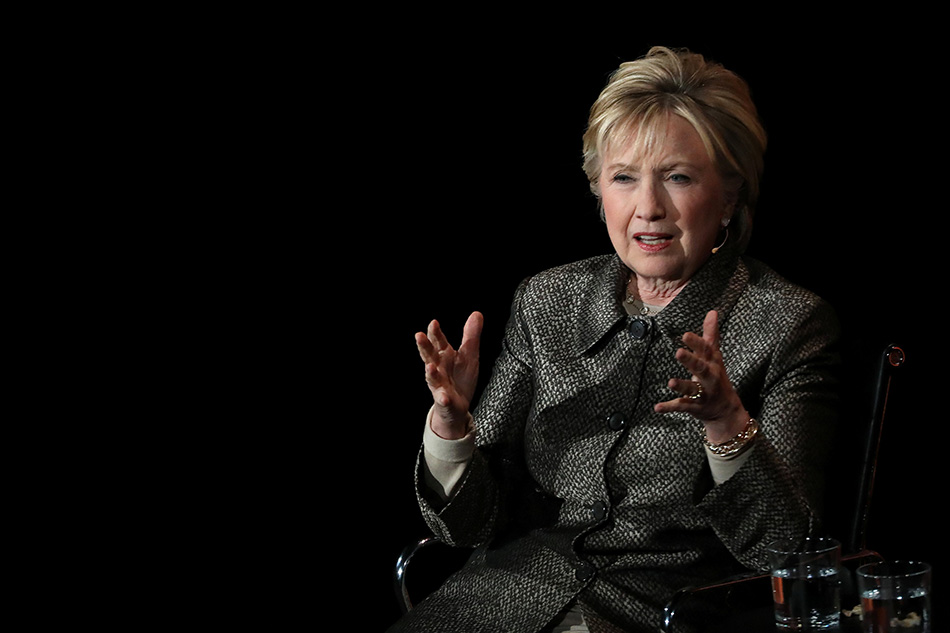
NEW YORK - In her first interview since her stunning presidential election defeat by Republican rival Donald Trump, Hillary Clinton on Thursday called for the United States to bomb Syrian air fields.

Clinton, in an interview at the Women in the World Summit in New York, also called Russian interference in the 2016 presidential election a theft more damaging than Watergate.

Asked whether she now believes that failing to take a tougher stand against Syria was her worst foreign policy mistake as secretary of state under President Barack Obama, Clinton said she favored more aggressive action against Syrian President Bashar al-Assad.

"I think we should have been more willing to confront Assad," Clinton said in the interview, conducted by New York Times columnist Nicholas Kristof.

"I really believe we should have and still should take out his air fields and prevent him from being able to use them to bomb innocent people and drop sarin gas on them."

Clinton noted that she had advocated for a no-fly zone in Syria after leaving government, something that Obama opposed.

Her remarks came two days after a poison gas attack in Syria that killed at least 70 people, many of them children. The U.S. government believes the chemical agent sarin was used in the attack. The United States and other Western countries blamed Assad's armed forces for the worst chemical attack in Syria in more than four years.

Trump said on Thursday that "something should happen" with Assad after the attack, as the Pentagon and the White House studied military options.

When asked about Russian interference in the presidential election she lost as the Democratic candidate in November, Clinton called for a bipartisan investigation.

"I don't want any Republican candidate to be subjected to what I was subjected to....I don't want anybody running campaigns to have their communications stolen," she said.

U.S. intelligence agencies have said that Russia provided hacked material from the Democratic National Committee to WikiLeaks through a third party. Russia has denied the hacking allegations.

"It was a more effective theft even than Watergate," Clinton told Kristof before an audience of about 3,000 people at New York's Lincoln Center, referring to the U.S. political scandal of the 1970s that led to the resignation of President Richard Nixon.

"We aren't going to let somebody sitting in the Kremlin, with bots and trolls, try to mix up our election. We've got to end that and we have to make sure that is a bipartisan, American commitment."

Representative Devin Nunes, a Republican, earlier on Thursday stepped aside from the congressional inquiry into Russian meddling in the U.S. presidential election because he is under investigation for disclosing classified information. Representative Mike Conaway, the second-ranked Republican on the House of Representatives intelligence committee, will now lead the probe.

Clinton attributed her White House loss to both Wikileaks and FBI Director James Comey's sending a bombshell letter to Congress only days before the election announcing he was reinstating an investigation into her emails.

Asked whether it was bittersweet to watch the stumbles of the Trump administration in its early days, she declined to agree.

"I don't take any pleasure in seeing the kind of chaotic functioning," Clinton said.

Clinton said she has no intention of another run for public office and said she is writing a book that, in part, delves into just what derailed her attempt to become America's first woman president.

"For people who are interested in this, the nearly 66 million people who voted for me, I want to give as clear and as credible an explanation as I can." (Reporting by Barbara Goldberg; Editing by Leslie Adler)

source: news.abs-cbn.com

Saturday, March 11, 2017

At least 40 killed in Damascus bombing targeting Shi'ites


BEIRUT/DAMASCUS — A double bomb attack targeting Shi'ite pilgrims in Damascus killed at least 40 Iraqis and wounded 120 more who were going to pray at a nearby shrine, the Iraqi foreign ministry said.

There was no immediate claim of responsibility for Saturday's attack, which the Hezbollah-run al-Manar TV station said had been carried out by two suicide bombers.

Footage broadcast by Syrian state TV showed two badly damaged buses with their windows blown out. The area was splattered with blood and shoes were scattered on the ground.

Syrian President Bashar al-Assad has been supported in the country's war by Shi'ite militias from countries including Iraq, Afghanistan and Lebanon.

The attack took place at a bus station where the pilgrims had been brought to visit the nearby Bab al-Saghir cemetery, named after one of the seven gates of the Old City of Damascus.

The second blast went off some 10 minutes after the first at around 10 a.m. local time, inflicting casualties on civil defense workers who had gathered to tend to the casualties, the Damascus correspondent for al-Manar told the station by phone.

The pilgrims were due to pray at the cemetery after visiting the Sayeda Zeinab shrine just outside Damascus, he said.

Sayeda Zeinab, the granddaughter of the Prophet Mohammad, is venerated by Shi'ites and her shrine is a site of mass pilgrimage for Shi'ites from across the world. It has also been a magnet for Shi'ite militiamen in Syria.

Iran has backed Assad in the conflict that erupted in 2011. The Iran-backed Lebanese group Hezbollah is also fighting in support of Assad.

The Syrian Observatory for Human Rights, a British-based organisation that reports on the war, said the number of dead was at least 44. The death toll was expected to rise due to the many serious injuries, it added.

Last June, Islamic State claimed responsibility for bomb attacks near the Sayeda Zeinab shrine. The last bomb attack in Damascus was in January, when a suicide bomber hit the heavily police Kafr Sousa neighbourhood, killing at least seven people.

(Additional reporting by Maher Chmaytelli in Baghdad; Editing by Alexander Smith and Dominic Evans)

source: news.abs-cbn.com

Saturday, December 17, 2016

Obama denounces Aleppo 'horror' as evacuation suspended


ALEPPO, Syria – Responsibility for atrocities committed in Aleppo lies with Syria and its Russian and Iranian backers, US President Barack Obama said Friday as Damascus suspended the evacuation of civilians and fighters from the city's last rebel-held areas.

Denouncing the "horror" in Aleppo, Obama called for impartial observers and warned President Bashar al-Assad that he would not be able to "slaughter his way to legitimacy".

"The world as we speak is united in horror at the savage assault by the Syrian regime and its Russian and Iranian regime on the city of Aleppo," he told an end-of-year news conference.

"This blood and these atrocities are on their hands."

UN Secretary General Ban Ki-moon earlier warned that Aleppo had become "a synonym for hell" and said the United Nations urged "all necessary measures" for a safe resumption of the evacuation.

The Security Council could vote as early as this weekend on a French-drafted proposal to allow international observers in Aleppo and ensure urgent aid deliveries.

US Ambassador Samantha Power said after a closed-door council meeting that UN officials were ready to be sent quickly to Aleppo.

"The presence of independent observers can deter some of the worst horrors," she said.

French Ambassador Francois Delattre said: "The immediate priority is to save lives, to stop the massacres and to avoid a new Srebrenica," referring to the massacre of Bosnian Muslims during the Balkan wars.

Russian Ambassador Vitaly Churkin, however, argued that it would take weeks to send monitors to Aleppo.

- Besieged villages –

Turkey and a Syrian military source said the evacuation from the city had been suspended but was not yet over, while Moscow insisted the operation was "complete", with all women and children moved from the city.

Amid the confusion, a convoy of evacuees that had already left the east when the operation was suspended was forced to turn back, an AFP correspondent said.

The International Committee of the Red Cross (ICRC), supervising the evacuations, said it was looking into reports of shooting before the convoy was turned back.

The delicate operation to bring the last civilians and rebels out of east Aleppo began on Thursday and continued overnight, with thousands leaving in buses and ambulances.

But on Friday morning it was abruptly suspended, with the government accusing rebels of violating the terms of the deal.

State television said rebels had tried to smuggle out heavy weapons and hostages.

The opposition accused the government of suspending the operation in a bid to secure the evacuation of residents from Fuaa and Kafraya, two villages under rebel siege in northwest Syria.

The government and Iran have reportedly sought to add an evacuation of civilians from the villages to the terms of the Aleppo deal.

The Britain-based Syrian Observatory for Human Rights said pro-government fighters had blocked the road the convoy had been using and rebels were refusing the evacuation of residents of Fuaa and Kafraya.

Evacuating the last rebel pocket in Aleppo had been scheduled to start on Wednesday, but was delayed by a day because of government objections, including over Fuaa and Kafraya.

Clashes resumed for several hours before the deal was revived, and buses and ambulances began transporting evacuees to rebel territory in western Aleppo province.

- Video message –

The Observatory estimated some 8,500 people had left before the operation was suspended, including around 3,000 rebels.

Syrian state media reported a figure of around 8,000.

Ahmad al-Dbis, a doctor helping coordinate the evacuation of the wounded, said at least 500 evacuees had wounds or illnesses requiring treatment.

From a staging area near the town of Khan al-Aasal people were travelling further west, heading either to camps for the displaced or to stay with relatives or friends.

The departures began a month to the day after government forces launched a major offensive to retake all of Aleppo and secure the regime's biggest victory in more than five years of conflict.

In a video message Thursday, Assad said the "liberation" of Aleppo was "history in the making".

But US Secretary of State John Kerry said what had already happened there was "unconscionable", raising concerns for the "tens of thousands of lives that are now concentrated into a very small area of Aleppo".

It is unclear how many people remain in east Aleppo, with tens of thousands fleeing to territory held by the government or Kurds in recent days, but perhaps tens of thousands are still inside.

- 'Heart-breaking' -

The evacuations have been emotional for departing residents desperate for relief after months of bombardment and siege, but also tearful at the prospect of potentially permanent exile.

In the dust of one bus window, someone traced: "One day we will return".

"The scene was heart-breaking," said Marianne Gasser from the ICRC Syria. "People are faced with impossible choices. You see their eyes filled with sadness."

A blast at a Damascus police station, meanwhile, was caused by a seven-year-old girl being sent in carrying "a bomb" that was detonated remotely, state news agency SANA said.

It was believed to be the first time such a young child has been used to detonate an explosive device in the war.

A police source told the Al-Watan daily that she asked to use the bathroom and the explosives detonated.

More than 310,000 people have been killed since the conflict began with anti-government protests in 2011, and over half the population has been displaced, with millions becoming refugees.

Diplomatic efforts -- including several rounds of peace talks in Geneva -- failed to make progress in resolving the conflict, which reached a turning point last year when Russia launched an air war in support of Assad.

source: news.abs-cbn.com

Thursday, December 15, 2016

Buses evacuate thousands of exhausted Aleppo residents in ceasefire deal

Buses evacuate thousands of exhausted Aleppo residents in ceasefire deal

* Medical convoy attacked earlier

* Operation to evacuate fighters, residents under way

* Recapture of city would give Assad biggest victory of war

* Wider conflict far from over


ALEPPO, Syria/BEIRUT - Thousands of people were evacuated on Thursday from the last rebel bastion in Aleppo, the first to leave under a ceasefire deal that would end years of fighting for the city and mark a major victory for Syrian President Bashar al-Assad.

A first convoy of ambulances and buses with nearly 1,000 people aboard drove out of the devastated rebel-held area of Aleppo, which was besieged and bombarded for months by Syrian government forces, a Reuters reporter on the scene said.

Syrian state television reported later that two further convoys of 15 buses each had also left east Aleppo. The second had reached the rebel-held area of al-Rashideen, an insurgent said.

The International Committee of the Red Cross said late on Thursday that some 3,000 civilians and more than 40 wounded people, including children, had already been evacuated.

ICRC official Robert Mardini told Reuters there were no clear plans yet for how to ship out rebel fighters, who will be allowed under the ceasefire to leave for other areas outside government control.

Women cried out in celebration as the first buses passed through a government-held area, and some waved the Syrian flag. Assad said in a video statement the taking of Aleppo - his biggest prize in more than five years of civil war - was a historic moment.

An elderly woman, who had gathered with others in a government area to watch the convoy removing the rebels, raised her hands to the sky, saying: "God save us from this crisis, and from the (militants). They brought us only destruction."

Wissam Zarqa, an English teacher in the rebel zone, said most people were happy to be leaving safely. But he said: "Some of them are angry they are leaving their city. I saw some of them crying. This is almost my feeling in a way."

Earlier, ambulances trying to evacuate people came under fire from fighters loyal to the Syrian government, who injured three people, a rescue service spokesman said.

"Thousands of people are in need of evacuation, but the first and most urgent thing is wounded, sick and children, including orphans," said Jan Egeland, the U.N. humanitarian adviser for Syria.

Staffan de Mistura, the U.N. special envoy for Syria, said about 50,000 people remained in rebel-held Aleppo, of whom about 10,000 would be evacuated to nearby Idlib province and the rest would move to government-held city districts.

Behind those fleeing was a wasteland of flattened buildings, concrete rubble and bullet-pocked walls, where tens of thousands had lived until recent days under intense bombardment even after medical and rescue services had collapsed.

The once-flourishing economic center with its renowned ancient sites has been pulverized during the war that has killed more than 300,000 people, created the world's worst refugee crisis and allowed for the rise of Islamic State.


'PLACE THEM ALL IN IDLIB'

The United States was forced to watch from the sidelines as the Syrian government and its allies, including Russia, mounted an assault to pin down the rebels in an ever-diminishing pocket of territory, culminating in this week's ceasefire.

U.S. Secretary of State John Kerry said on Thursday that the Syrian government was carrying out "nothing short of a massacre" in Aleppo. U.N. aid chief Stephen O'Brien will brief the Security Council on Friday on the Aleppo evacuation.

The Syrian White Helmets civil defense group and other rights organizations accused Russia of committing or being complicit in war crimes in Syria, saying Russian air strikes in the Aleppo region had killed 1,207 civilians, including 380 children.

In a letter submitted to the U.N. Commission of Inquiry on Syria and seen by Reuters on Thursday, the groups listed 304 alleged attacks carried out in the Aleppo area primarily between July and December and said there was a "high likelihood" of Russia responsibility.

The Russian U.N. mission was not immediately available to comment on the allegations. Russia has said it stopped air strikes in Aleppo in mid-October.

In Aleppo's rebel-held area, columns of black smoke could be seen as residents hoping to depart burned personal belongings they do not want to leave for government forces to loot.

A senior Russian general, Viktor Poznikhir, said the Syrian army had almost finished its operations in Aleppo.

But the war will still be far from over, with insurgents retaining their rural stronghold of Idlib province southwest of Aleppo, and the jihadist Islamic State group holding swathes of the east and recapturing Palmyra this week.

Rebels and their families would be taken towards Idlib, a city in northwestern Syria that is outside government control, the Russian Defence Ministry said.

Idlib province, mostly controlled by hardline Islamist groups, is not a popular destination for fighters and civilians from east Aleppo, where nationalist rebel groups predominated.

A senior European diplomat said last week the fighters had a choice between surviving for a few weeks in Idlib or dying in Aleppo. "For the Russians it's simple. Place them all in Idlib and then they have all their rotten eggs in one basket."

Idlib is already a target for Syrian and Russian air strikes but it is unclear if the government will push for a ground assault or simply seek to contain rebels there for now.

The International Rescue Committee said: "Escaping Aleppo doesn't mean escaping the war ... After witnessing the ferocity of attacks on civilians in Aleppo, we are very concerned that the sieges and barrel bombs will follow the thousands who arrive in Idlib."

SHI'ITE VILLAGES
The evacuation deal was expected to include the safe passage of wounded from the Shi'ite villages of Foua and Kefraya near Idlib that are besieged by rebels. A convoy set off to evacuate the villages on Thursday, Syrian state media said.

Efforts to evacuate eastern Aleppo began earlier in the week with a truce brokered by Russia, Assad's most powerful ally, and Turkey, which has backed the opposition. That agreement broke down following renewed fighting on Wednesday and the evacuation did not take place then as planned.

A rebel official said a new truce came into effect early on Thursday. Shortly before the new deal was announced, clashes raged in Aleppo.

Government forces made a new advance in Sukkari - one of a handful of districts still held by rebels - and brought half of the neighborhood under their control, according to the Syrian Observatory for Human Rights, a monitoring group.

The Russian Defence Ministry said - before the report of the government forces' advance in Sukkari - that the rebels controlled an enclave of only 2.5 square km (1 square mile).

The evacuation plan was the culmination of two weeks of rapid advances by the Syrian army and its allies that drove insurgents back into an ever-smaller pocket of the city under intense air strikes and artillery fire.

By taking control of Aleppo, Assad has proved the power of his military coalition, aided by Russia's air force and an array of Shi'ite militias from across the region.

Rebels have been backed by the United States, Turkey and Gulf monarchies, but that support has fallen far short of the direct military assistance given to Assad by Russia and Iran.

Russia's decision to deploy its air force to Syria more than a year ago turned the war in Assad's favor after rebel advances across western Syria. In addition to Aleppo, he has won back insurgent strongholds near Damascus this year.

source: news.abs-cbn.com

Thursday, October 6, 2016

Obama weighs fresh Syria sanctions


WASHINGTON - With diplomacy faltering and Aleppo under siege, President Barack Obama is considering fresh Syria sanctions that could claw deeper into the regime and target its Russian backers.

Officials and diplomats said the strategy is still being thrashed out, but initial efforts could focus on passing UN sanctions against those implicated in chemical weapons attacks.

A UN-backed panel is expected in the next few weeks to present new findings about deadly chemical attacks in 2014 and 2015.

The panel -- formed by the United Nations and the independent Organization for the Prohibition of Chemical Weapons -- has already pinned the blame on the Syrian Air Force.

But the latest report, due before October 27, is expected to go into more detail about who is responsible, paving the way for targeted sanctions.

Supporters say the sanctions would send a signal that despite years of fighting, innumerable atrocities and at least 300,000 deaths, some small measure of accountability in Syria remains.

And while most of President Bashar al-Assad's inner circle and top military aides are already the subjects of US travel bans and assets freezes, officials believe that targeting lower-level military officers would have a chilling effect on Syrian military morale.

But the greatest impact may be diplomatic.

A demand for sanctions would put Russia in the uncomfortable position of defending chemical weapons use by its ally, and could force Moscow to wield its veto in the UN Security Council.

The report had earlier been delayed, partly to provide space for US and Russian efforts to broker a ceasefire.

Those have now failed, heaping pressure on Obama to act to stop the carnage in Syria.

"What we are doing now is a different type of diplomacy -- one which might be more robust -- it could be resolutions which are designed to put pressure on them," a Security Council diplomat said.

"The strategy that we are on is to try to change Russian behavior and let's face it we have not been very successful at that in the year that they have been militarily supporting Assad," the diplomat added.

"There is already work going on a draft resolution to take forward the 3rd and further 4th report in terms of what we do about it."

GAINING LEVERAGE

If the UN route fails, attention is likely to turn to sanctions agreed by the United States, the European Union and other allies.

Officials indicated the scope could be broad, covering not only Syrians but also Russian firms that provided the means to carry out the bombing of civilian areas.

That would be intended as a strong signal to Moscow that it is not immune and continued support for the regime would come at a price.

The sanctions would be targeted at specific firms -- aircraft parts suppliers or chemicals producers -- to overcome opposition in European capitals to broad sanctions against Russia, a major trading partner.

But with Russia and Syria dropping bombs on besieged Aleppo and a humanitarian crisis of historic proportions looming, key hurdles to action have fallen away.

German Chancellor Angela Merkel, eyeing the carnage in Aleppo and the severity of the refugee crisis that has rocked Europe, is reportedly taking a tougher line.

After a call with Obama last week, the two leaders decried "barbarous Russian and Syrian regime airstrikes against eastern Aleppo," saying in unusually strong language that Moscow and Damascus bear a special responsibility to stop the fighting.

But none of the sanctions options under consideration is likely to directly end fighting in Aleppo.

Several officials poured cold water on the idea that Obama would reverse years of opposition to military action against the regime by approving air or cruise missile strikes against airfields or other targets.

"There are significant consequences for using US military force against the Assad regime," White House spokesman Josh Earnest said. "I'd say the most important of those consequences that we should be mindful of is dragging the United States into another ground war in the Middle East."

Sending in troops "would have grave consequences for our national security," he added. "It would be expensive, it would put at risk more American lives and it's unclear how a conflict like that would end."

Obama was elected with a mandate to draw down the wars in Iraq and Afghanistan.

He has sent around 300 troops to Syria, focused on the battle against the Islamic State group, but has refused to plunge them into a civil war that is not deemed in America's strategic interest.

He has backed diplomacy instead as the only way out of the crisis.

But with just months left in office, the siege and bombardment of Syria's second city has put his reluctance to use force in Syria back under the spotlight, exposing deep unease within his administration.

source: www.abs-cbnnews.com

Thursday, March 31, 2016

Assad says civil war has cost Syria USD200 billion


MOSCOW - The brutal five-year conflict in Syria has cost the country over $200 billion (176 billion euros), President Bashar al-Assad said in an interview released Wednesday, insisting Damascus would look to Russia, China and Iran to rebuild the nation.

"The economic damage and the damage to infrastructure exceeds $200 billion," Assad told Russian state news agency RIA Novosti.

"Economic issues can be settled immediately, when the situation stabilizes in Syria, but rehabilitating the infrastructure will take a long time," Assad said in comments translated into Russian.

The Syrian strongman said any future contracts to help rebuild the country would be handed out to companies from nations that had backed Damascus during the bloody conflict.

"Of course we expect that this process will be based on three main countries that supported Syria during this crisis -- Russia, China and Iran," Assad said.

Russia has deployed its military to Syria to back up troops loyal to longstanding ally Assad with a bombing campaign, and the Syrian leader said Moscow's forces would be needed in the country for some time to come.

"We need their presence as they are effective in the fight against terrorism even if the situation in terms of security in Syria is stabilizing," Assad said, adding that Russia's bases were also required to maintain "balance in the world".

Moscow announced it was withdrawing part of its forces from Syria on March 14 after a ceasefire between Damascus and moderate opposition saw fighting drop.

Russia has, however, continued air strikes against Islamic State jihadists and played a key role in helping Assad's forces reclaim the ancient city of Palmyra at the weekend.

source: www.abs-cbnnews.com

Monday, September 15, 2014

US official warns Assad not to target US planes


WASHINGTON - US forces will target Syrian anti-aircraft systems if they take aim at American planes conducting strikes inside Syria against Islamic State rebels, a senior US official warned Monday.

Speaking on condition of anonymity, the official said that Washington had a good sense of where hostile Syrian batteries were located and US pilots would be tasked with rules of engagement that would allow them to protect themselves.

Last week, President Barack Obama announced that he would expand air strikes against IS in Iraq and was prepared to strike at the militant group in Syria.

In response, Syrian National Reconciliation Minister Ali Haidar said that any action against the jihadist group on Syrian territory without the consent of the Damascus government would be viewed as an attack on Syria.

The senior US official said that Syrian President Bashar al-Assad would have a choice to make in the event of US strikes against IS.

If Assad used military capabilities to interfere with the US capacity to strike at IS in Syria, he would put units involved in such action at risk, the official said.

Obama has ruled out the idea that his government could cooperate with Assad's forces to go after a common enemy in the Islamic State, which has overrun large areas of northern Iraq and Syria.

The US government sees Assad as tantamount to a war criminal who has turned the horror of civil war on his own people. Washington has consistently said that he should leave power.

source: www.abs-cbnnews.com

Monday, August 26, 2013

Assad warns US of failure if it attacks Syria


MOSCOW - Syrian President Bashar al-Assad said Western claims his regime used chemical weapons were an "insult to common sense" and warned the United States it faced failure if it attacked, in an interview with a Russian newspaper published Monday.

Assad told pro-Kremlin daily Izvestia in an extensive interview that Syria would never be a "puppet" of the West and said Washington had never succeeded in reaching its political aims through war.

"The comments (accusing the regime of using chemical weapons) made by politicians in the West and other countries are an insult to common sense... It is nonsense," Assad said.

Assad accused the United States of first making the accusations that his regime used chemical weapons in an attack outside Damascus that activists say killed hundreds, and only later starting to look for proof.

He said the frontline in the area where the incident took place was not clear and the Syrian regime would have risked killing its own army forces if it used chemical weapons.

"This contradicts elementary logic," Assad said.

"Such accusations are completely political and the reason for them is a number of victories by the government forces against the terrorists."

He said it is "not us but our enemies who are using chemical weapons."

With calls mounting for military action against Syria, Assad warned Western states to stop interfering in the affairs of other countries and instead "listen to the opinion of the people".

"If someone is dreaming of making Syria a puppet of the West, then this will not happen.

"We are an independent state, we will fight against terrorism and we will build relations with whom we want for the good of the Syrian people."

He warned the United States against attacking Syria and argued Washington's previous military campaigns in recent years had always fallen short of their aims.

"The United States faces failure just like in all the previous wars they waged, starting with Vietnam and up to our days," he said.

"America has taken part in many wars but could not once achieve its political goals for which the wars were started. Yes, it is true, the great powers can wage wars but can they win them?" he asked.

Russia is seen as Assad's last remaining major ally and has also backed his position on the claimed chemical attack, implying it was staged by the rebels with the aim of discrediting the regime.

Assad said he is in touch with Russian President Vladimir Putin "from time to time", not by telephone, but by intermediaries visiting respective capitals.

Asked about Russia's hugely controversial contract to deliver Damascus with S-300 missile systems, Assad said that "all contracts agreed with Russia are being fulfilled."

"Russia is supplying Syria with what is needed to protect Syria and its people," he said.

His comments came as Russian Foreign Minister Sergei Lavrov warned US Secretary of State John Kerry over the "extremely dangerous consequences" of launching military action against the Syrian regime.

However Assad also launched a rambling diatribe against Muslim states who are strongly supportive of the rebels.

Assad said Qatar was a "sponsor of terrorists" while Turkey "trains and provides corridors for them".

Saudi Arabia, meanwhile, was a country "which only has money and someone who has just money cannot create a civilised society," Assad said.

Asked about the chances of organising the so-called Geneva-2 peace conference backed by Russia and the United States, Assad replied: "We cannot start a political dialogue until the support from abroad for terrorism is halted."

source: www.abs-cbnnews.com