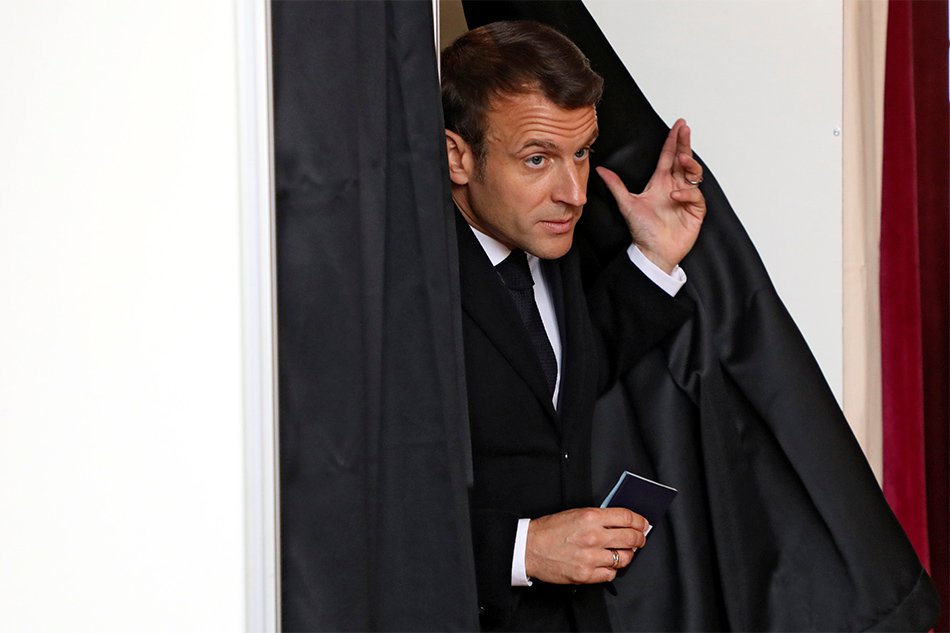
PARIS -- The far-right National Rally party led by Marine Le Pen finished top in European elections in France, final results showed Monday, dealing a symbolic blow, but not a knock-out punch, to pro-EU President Emmanuel Macron.
Le Pen's National Rally (RN) received 23.31 percent of the vote, with Macron's centrist alliance trailing with 22.41 percent.
The two groups will have the same number of seats in the European Parliament, 23, after Britain's expected departure from the EU.
Le Pen, who lost out to Macron in a bitter presidential contest in 2017, called for the head of state to dissolve the parliament and call new elections, a proposal that was immediately rejected by the government.
"It is up to the president of the republic to draw conclusions, he who put his presidential credit on the line in this vote in making it a referendum on his policies and even his personality," Le Pen said in a brief speech late Sunday.
But despite triumphalist comments from RN figures, the final results were a mixed picture for the 50-year-old Le Pen: her party ended up losing ground since European elections in 2014 when it finished top with 24.9 percent.
In a first reaction after exit polls were released late on Sunday, an aide to Macron called them "respectable". Leading allies of the 41-year-old president sounded satisfied that the margin of defeat looked like it would be slender.
A second-place finish for the ruling Republic on the Move (LREM) party was a disappointment for Macron after he put his reputation on the line by campaigning, but it is a symbolic setback that aides said would have no bearing on his policies.
"The catastrophe that some people predicted for Macron has not taken place and the RN has a significant score, but not a spectacular one when you compare it to five years ago," analyst Zaki Laidi from the Cevipof political institute said.
'TIME FOR ACTION'
An aide to Macron, speaking to AFP on condition of anonymity, said that there would be "no change of line" and that he would intensify his planned reforms which include tax cuts for the middle classes and controversial changes to the pension and unemployment benefits system.
Prime Minister Edouard Philippe said the results confirmed the "redrawing" of French politics, which was evident in the presidential election in 2017 when France's traditional parties were eclipsed by Macron's new centrist movement and the far-right.
"The time is for action because the French people will judge us ultimately on one thing: results," Philippe said in a televised statement on Sunday.
He also said the government had "received a message about the ecological emergency" after France's main green party, EELV, looked set to finish third, with around 13 percent of the vote compared with 8.9 percent in 2014.
Macron had made no secret of the significance he attached to the results, telling regional French newspapers last week that the EU elections were the most important for four decades as the union faced an "existential threat".
He is a leading champion of further EU integration and is keen for further advances to link the economies, militaries and political systems of the bloc, which numbers 28 member states including Britain.
At home, the former investment banker started his 5-year term as an energetic pro-business reformer intent on cutting unemployment and making France more entrepreneurial.
But for 6 months he has faced so-called "yellow vest" protesters who have blocked roads and demonstrated to denounce him as a "president of the rich" who has ignored the plight of the working poor and rural France.
Macron has since announced major tax cuts for the middle classes and a rise in the minimum wage.
ALLIES?
His influence and Le Pen's in the European parliament will now depend on whether they can make alliances.
Le Pen has previously called for the formation of a "supergroup" of eurosceptic parties, but the hard-right ruling party in Poland -- PiS -- has shunned her because of her pro-Russian views, while Hungary's Prime Minister Viktor Orban remains aloof.
"The gains for our allies in Europe and the emergence of new forces across the continent... open the way for the formation of a powerful group in the European parliament," the RN's top campaigner, 23-year-old Jordan Bardella, told supporters on Sunday.
Macron meanwhile is in alliance with the ALDE centrist and liberal grouping which is seen as finishing third in the parliament behind the conservative PPE formation and the center-left Socialists and Democrats (S&D).
But the French president, who redrew French politics in 2017, is still hoping to forge a new broader alliance of pro-European which would bring together so-called "progressives."
"At the European level, the president is still maneuvering to form a large progressive alliance, a force that will be essential in the new parliament," an aide said on condition of anonymity.
source: news.abs-cbn.com

BERLIN - Europe's political establishment entered 2017 in a state of panic. Britain had voted to leave the European Union six months before and the United States had just elected a president who was hostile to their grand project and the values it stood for.
The same forces that had led to Brexit and Donald Trump - popular anger with distant elites, economic inequality and immigration - threatened to hit the continent hard in a year in which Europe's largest countries were holding elections.
The biggest risk of all was France, a country with an ailing economy, historic ambivalence toward the EU and a politician, in National Front leader Marine Le Pen, who seemed well positioned to seize on voter fears.
Instead, on Sunday, Le Pen was soundly defeated by Emmanuel Macron, a 39-year-old independent who ran on an unashamedly pro-European platform.
Macron urged the French to embrace rather than reject globalization. And he vowed to work with Germany to relaunch the European Union, a project long seen as a guarantor of peace and prosperity but one which is now struggling to find its "raison d'etre" after years of crisis.
Macron's victory represents a reprieve for Europe and the liberal democratic values for which it has stood for more than half a century.
The nightmare scenarios that were whispered about in European capitals in early 2017 have not materialized. Europe has been given another chance. Those are the main messages from Macron's victory and they were reflected in the reactions from Europe on Sunday.
"Hurrah Macron President! There is hope for Europe!" Italian Prime Minister Paolo Gentiloni tweeted.
German Chancellor Angela Merkel's spokesman called it a victory for a "strong united Europe" and for German-French friendship.
WARNING
But the French vote was also a warning. Le Pen's National Front won 35 percent of the vote, nearly double what her father Jean-Marie secured in 2002, a result which hit the nation like an earthquake at the time, triggering a broad "Republican front" to block him.
In this election the sense of shock and anti-Le Pen front proved far weaker. On Sunday night she took to a stage in Paris and called on "all patriots" to join her in opposition to the new president.
Nigel Farage, former leader of Britain's UKIP party and a leading campaigner for Brexit, said what many in Europe may be thinking when Sunday night celebrations wear off: "If Marine sticks in there, she can win in 2022."
Macron and his fellow European leaders face a formidable challenge over the next five years to prevent that from happening.
For his part, Macron must unite a deeply divided country and deliver on his promise to inject new life into its moribund economy by delivering jobs for young people and hope for the immigrants in depressed working class suburbs around France's major cities.
Former U.S. president Barack Obama who openly backed Macron last week and whose message of hope served as a model for the French candidate is a cautionary tale for what can happen when some promises go unfulfilled.
"Macron has 12 to 15 months to take the necessary decisions so that the benefits are visible before the end of his term," said a senior German official who requested anonymity.
At the European level, he must convince German Chancellor Angela Merkel - who looks on track to win re-election in September after another strong performance by her conservatives in a regional vote on Sunday - to develop a common vision for taking Europe forward.
The good news is that Macron and Merkel are likely to have other like-minded leaders to work with. Mark Rutte, the liberal prime minister of the Netherlands, fended off a challenge from far-right Freedom Party leader Geert Wilders in an election in March.
And next year may see the return of another young pro-European centrist in Matteo Renzi, who was forced to resign as Italian prime minister in December, but now looks on course for a comeback after regaining the leadership of his Democratic Party (PD) in a primary vote last week.
"Hard to overemphasize how much this will change the narrative about the EU. No longer the world's sick man," tweeted Nicolas Veron, an economist at Brussels think tank Bruegel.
Still, the anti-establishment wave seems unlikely to disappear anytime soon. In Poland and Hungary, right-wing governments are already flouting EU rules.
And opposition politicians like Le Pen and Wilders have gained a stronger platform from which to promote their messages.
They may also learn lessons from their recent defeats.
Le Pen said on Sunday that the National Front would be completely overhauled. Her deputy said the party would get a new name. And her father Jean-Marie said her campaign had been undermined by its proposals to quit the euro and the European Union, suggesting they might temper policies that spooked many French voters.
"Even if the globalists have won today, it doesn't mean that the populists won't win tomorrow," said Daniele Antonucci of Morgan Stanley.
(Reporting by European bureaus; writing by Noah Barkin; editing by Philippa Fletcher and Richard Balmforth)
source: news.abs-cbn.com

PARIS - Far-right candidate Marine Le Pen and centrist Emmanuel Macron clashed over their vision of France's future and ways of handling terrorism in an ill-tempered televised debate on Wednesday ahead of Sunday's run-off vote for the presidency.
The two went into the debate with opinion polls showing Macron, 39, maintaining a strong lead of 20 percentage points over the National Front's Le Pen, 48, in what is widely seen as France's most important election in decades.
For Le Pen, the debate, watched by millions, was a last major chance to persuade voters of the merits of her program which includes cracking down on illegal immigration and ditching the euro currency.
In angry exchanges, Le Pen played up Macron's background as a former investment banker and economy minister, painting him as a continuation of the outgoing unpopular Socialist government and a backer of rampant globalization. He accused her of not offering solutions to problems such as France's chronic unemployment.
But the sharpest exchange was over national security, a sensitive issue in a country where more than 230 people have been killed by Islamist militants since 2015.
Le Pen accused Macron of being complacent in confronting the threat of Islamist fundamentalism. "You have no plan (on security) but you are indulgent with Islamist fundamentalism," she said.
Macron retorted that terrorism would be his priority if he is elected and accused Le Pen of being simplistic. "What you are proposing is snake oil," he said, referring to her proposals to close France's borders.
"I will lead a fight against Islamist terrorism at every level. But what they are wanting, the trap they are holding out for us, is the one that you offer - civil war," he said..
"GLOBALIZATION GONE WILD"
Le Pen labeled Macron a "smirking banker" and said he represented unfettered globalization.
"Mr. Macron is the candidate of globalization gone wild, of Uberisation, of precariousness, of social brutality, of war by everybody against everybody ... of the butchering of France by big economic interests," she said, referring to the gig economy typified by U.S. app-based cab service Uber.
Macron hit back by calling Le Pen a liar, saying she was talking nonsense and that her rhetoric lacked substance.
On unemployment, Macron told Le Pen: "Your strategy is simply to tell a lot of lies and just to say what isn't going right in the country."
The two candidates, seated opposite one another at a table in the television studios, mapped out diametrically opposed visions for France. Macron calls for liberal reforms to kickstart the French economy, while Le Pen rails against the loss of French jobs through off-shoring and would adopt protectionist trade measures.
Macron finished only three points ahead of Le Pen in the first round on April 23, but he is widely expected now to pick up the bulk of votes from the Socialists and the center-right whose candidates were eliminated.
Though Le Pen has a mountain to climb, the campaign has been packed with surprises.
Upwards of 20 million viewers out of an electorate of close to 47 million were expected to tune in to the two-and-a-half hour debate.
In an interview with Reuters on Tuesday Le Pen reaffirmed she wanted to take France out of the euro and get a national currency back into French pockets within two years.
Wednesday's event marks the first time a National Front candidate has appeared in a run-off debate - an indication of the degree of acceptance Le Pen has secured for the once-pariah party by softening its image in an attempt to dissociate it from past xenophobic associations.
Outgoing President Hollande, hours before the two rivals sat down before the cameras, renewed a call to stop Le Pen and vote for Macron.
A Cevipof poll published on the website of Le Monde on Wednesday - one of the last big surveys before Sunday's vote - saw Macron getting 59 percent of votes versus 41 percent for Le Pen. An Ifop-Fiducial poll for Paris Match, CNews and Sud Radio gave Macron a 60-40 lead.
His camp meanwhile said that, if elected, he might put back a deadline for cutting back reliance on nuclear power in the French energy mix - an announcement that sent EDF shares up 4.9 percent in heavy trade.
Assuming he wins, one of Macron's immediate tasks will be to build a parliamentary majority in follow-up elections in June to push through his program.
He heads only a fledgling movement called En Marche! (Onwards!) which has no representation in parliament.
A poll for Les Echos newspaper by OpinionWay-SLPV Analytics suggested Macron was rising to that challenge, showing his party set to emerge as the largest with between 249 and 286 seats in the 577-seat lower house, while the National Front was tipped to win 15 to 25.
(Additional reporting by Sudip Kar-Gupta, Elizabeth Pineau, Simon Carraud, and Geert De Clercq; Writing by Adrian Croft; Editing by Richard Balmforth)
source: news.abs-cbn.com

PARIS - Far-right presidential candidate Marine Le Pen said on Tuesday she was better placed than her rival, centrist Emmanuel Macron, to defend France's interests in what she called the "new world" of US President Donald Trump and Russia's Vladimir Putin.
Le Pen, who rails against "uncontrolled globalization", hopes to channel the same nationalist, anti-establishment sentiment that propelled Trump to the White House and spurred Britain's vote to leave the European Union, and become the first woman to lead France.
She bills Macron, a pro-European Union former investment banker, as a stooge of banks and the elite.
"I think I'm best placed to talk to this new world that's emerging, to talk to the Russia of Putin, to the United States of Trump, to talk to the Britain of (Prime Minister Theresa) May ... to talk to the India of (Prime Minister Narendra) Modi," she said in an interview.
She said that was "because all of those countries are more or less turning their backs on the ideology of free trade, of competition and of undermining social protection.
"So I feel much more in line with their political philosophy than with (German Chancellor Angela) Merkel's," she told Reuters, speaking at her campaign headquarters.
Behind her stood the French national flag and a poster with the slogan "Choosing France".
Despite the Brexit vote, Britain says it remains a defender of free trade. Trump has said he wants trade deals to work for the United States.
ANTI-ESTABLISHMENT
Le Pen goes into Sunday's decisive run-off the clear underdog, according to opinion polls. While her policies of economic nationalism and stinging anti-EU rhetoric strike a chord among workers in low-income areas, she struggles for support in France's main cities.
Macron calls her a demagogue and a heiress raised in a chateau, with no experience outside far-right politics.
The winner of the second round will lead a core member of the European Union and the NATO alliance, a permanent member of the United Nations Security Council, and the euro zone's second largest economy.
Asked what she thought of the hurdles Trump had faced in his first 100 days in office, including his failure to push a repeal and replacement of Obamacare through Congress, a core campaign promise, she said:
"It shows the establishment exists and is trying to fight against the democratic result of the people. You can see that a part of the system is uniting to stop Donald Trump from putting in place the measures which were chosen by the people."
Asked about Trump's boast in a 2005 video about grabbing women by the genitals, she said: "It's true his comments were worthy of criticism but they were private comments ... what's most important is the policies he implements."
"I don't think that he's implementing policies which aim to roll back the rights of women," she added.
(Writing by Ingrid Melander; editing by Richard Lough)
source: news.abs-cbn.com

PARIS - France goes to the polls on Sunday for the first round of a bitterly fought presidential election, crucial to the future of Europe and a closely-watched test of voters' anger with the political establishment.
Nearly 47 million voters will decide, under tight security, whether to back a pro-EU centrist newcomer, a scandal-ridden veteran conservative who wants to slash public spending, a far-left eurosceptic admirer of Fidel Castro or appoint France's first woman president, to shut borders and ditch the euro.
The outcome will be anxiously monitored around the world as a sign of whether the populist tide that saw Britain vote to leave the EU and Donald Trump's election in the United States is still rising, or starting to ebb.
Emmanuel Macron, 39, a centrist ex-banker who set up his party just a year ago, is the opinion polls' favorite to win the first round and beat far-right National Front chief Marine Le Pen in the two-person run-off on May 7.
For them to win the top two qualifying positions on Sunday would represent a seismic shift in the political landscape, as the second round would feature neither of the mainstream parties that have governed France for decades.
"It wouldn't be the classic left vs right divide but two views of the world clashing," said Ifop pollsters' Jerome Fourquet. "Macron bills himself as the progressist versus conservatives, Le Pen as the patriot versus the globalists."
But conservative Francois Fillon is making a bit of a comeback after being plagued for months by a fake jobs scandal, and leftist Jean-Luc Melenchon's ratings have surged in recent weeks. Any two of the four is seen as having a chance to qualify for the run-off.
The seven other candidates, including the ruling Socialist party's Benoit Hamon, two Trotskyists, three fringe nationalists and a former shepherd-turned-centrist lawmaker are lagging very far behind in opinion polls.
Months of campaigning has been dominated by scandals which have left many voters agonizing over their choice. Some 20-30 percent might not vote and about 30 percent of those who plan to show up at the polling stations are unsure whom to vote for.
Adding uncertainty to France's most unpredictable election in decades, pollsters say they might not be able to give precise estimates of the outcome at 8 p.m. (1800 GMT) as usual, because small and medium-sized polling stations will be open one hour longer than in past elections.
"CHEERING MADLY"?
Bankers and brokers in Paris and far beyond are expected to be glued to their screens all evening. The possibility of a Le Pen-Melenchon run-off is not the most likely scenario but is one which alarms them.
While Macron wants to further beef up the euro zone, Le Pen has told supporters "the EU will die." She wants to return to the Franc, re-denominate the country's debt stock, tax imports and reject international treaties.
Melenchon also wants to radically overhaul the European Union and hold a referendum on whether to leave the bloc.
Le Pen or Melenchon would struggle, in parliamentary elections in June, to win a majority to carry out such radical moves, but their growing popularity worries both investors and France's EU partners.
"It is no secret that we will not be cheering madly should Sunday's result produce a second round between Le Pen and Melenchon," German Finance Minister Wolfgang Schaeuble said, adding that the election posed a risk to the global economy.
Both U.S. President Donald Trump and his predecessor Barack Obama have shown interest in the vote.
Obama spoke with Macron over the phone on Thursday, and Trump said the following day he expected the killing of a policeman by a suspected Islamist in Paris to boost Le Pen's chances.
Previous militant attacks, such as the November 2015 killings in Paris ahead of regional polls, did not appear to boost the votes of those espousing tougher national security.
If either Macron or Fillon were victorious, each would face challenges.
For Macron, a big question would be whether he could win a majority in parliament in June. Fillon, though likely to struggle less to get a majority, would likely be dogged by an embezzlement scandal, in which he denies wrongdoing.
Some 67,000 polling stations will open at 8 a.m., monitored by more than 50,000 police officers.
(Writing by Ingrid Melander; editing by Andrew Roche)
source: news.abs-cbn.com