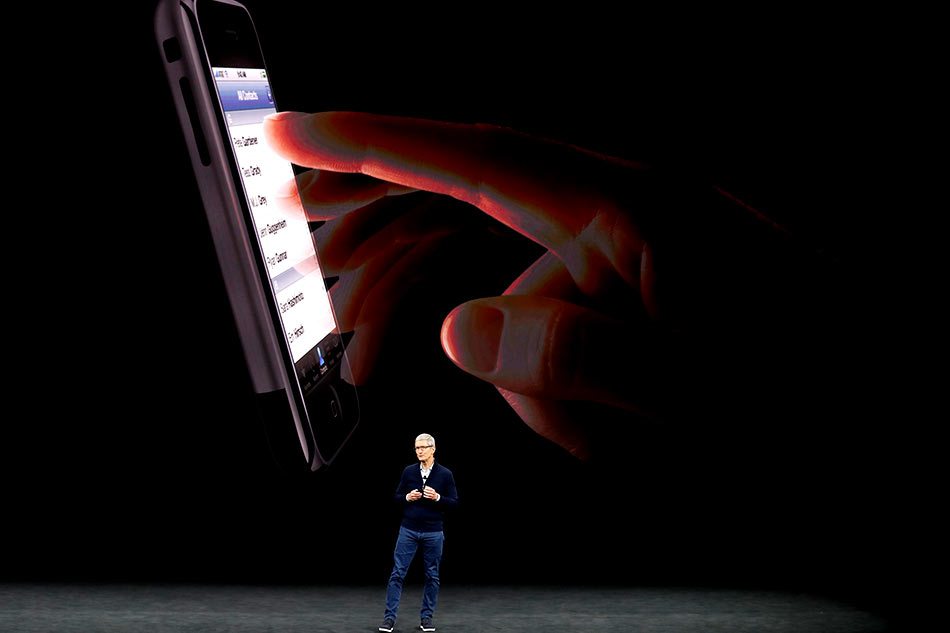
MANILA - Apple officially priced its iPhone X in the Philippines ahead of its Dec. 1 release, as the 8 and 8 Plus models went on sale on Friday.
The near bezel-less iPhone X, the handset's most radical redesign since 2014, will cost a minimum P64,490, according to Apple's Philippine page. The base models sells for roughly P67,000 in unofficial stores.
In the US, the base model with 64 gigabytes of storage sells for $999 or roughly P51,000.
Apple priced the iPhone 8 Plus at P51,490 for the 64 GB model and P60,990 for the 256 GB variant, according to its website.
The smaller iPhone 8 starts at P44,990 for the base 64 GB model and P54,490 for the 256 GB model.
Local carriers Globe and Smart have also released their pricing for the new iPhones.
source: news.abs-cbn.com

Apple shifted much of its offshore wealth in the face of a tax crackdown on a haven it had in Ireland, according to reporting Monday on the Paradise Papers on the iPhone maker's tax strategy.
After the US technology colossus stated publicly in 2013 that it was paying its proper share of taxes, it moved the bulk of its untaxed overseas cash to the Channel Islands jurisdiction Jersey, the New York Times and BBC reported based on a once-secret cache of documents referred to as the Paradise Papers.
The documents shared with some media outlets by the US-based International Consortium of Investigative Journalists has exposed tactics the wealthy and powerful have used to avoid taxes.
Prior to 2014, California-based Apple had taken advantage of tax rules to route overseas revenue through Irish subsidiaries to minimize taxes.
As Apple came under pressure in the US and Europe about what was called the "double Irish" scheme it enlisted offshore finance law firm Appleby to find a new place to stash cash out of reach of tax collectors, according to reporting.
Apple settled on Jersey, a dependency of the United Kingdom, which had a tax rate of zero for foreign companies, reports indicated.
Emails cited in coverage indicated Apple wanted the arrangement kept secret.
Apple is now facing an EU demand for some $14.5 billion in taxes based on a ruling that its tax structure in Ireland amounted to illegal state aid.
Appleby was cited as the source of much of the leaked financial data that has resulted in searing revelations in recent days.
Apple did not reply to an AFP request for comment, but has previously gone on record saying it pays all taxes required by law and that the amount it substantial.
The documents show details of offshore deals involving a US cabinet member, a fundraiser for Canada's prime minister, Queen Elizabeth II and others.
source: news.abs-cbn.com

Apple Inc's shares rose to a record high on Friday as more analysts set a trillion-dollar valuation on the company, following a blowout fourth quarter and an upbeat forecast that quashed investor concerns around the iPhone X.
The stock rose as much as 3.7 percent to $174.26, briefly breaching $900 billion in market value, amid declines in the broader market. The gains added nearly $32 billion to the company's market capitalization.
The Cupertino, California-based company also forecast a strong holiday quarter ahead, which will include the iPhone X that started selling on Nov. 3.
"We see iPhone X unlocking pent-up iPhone upgrades, especially in China, driving more than 20 percent iPhone unit growth and a revenue and earnings beat in 2018," analyst Katy Huberty on Morgan Stanley said.
The glass-and-steel $999 phone appeared to have brought back the frenzy associated with iPhone launches - long lines formed outside Apple stores across the world as fans flocked to buy the new phone.
The company will make 30 million iPhone X units during the current quarter, Nomura Instinet analysts estimated, allaying production worries related to the phone.
IPhone X's launch follows weeks of concerns among analysts about the production of the phone, which for the first time includes new facial identification software to replace the fingerprint used on previous phones.
Apple said on Thursday it expects first-quarter revenue of $84 billion to $87 billion, at the high end of analysts' average expectation of $84.18 billion, according to Thomson Reuters I/B/E/S.
"We – and many others – had feared that guidance could be weaker, reflecting only 9 weeks of the flagship iPhone X and limitations on supply," Bernstein analyst Toni Sacconaghi said.
At least 13 brokerages raised their price targets on the stock, with Citigroup making the most bullish move by raising its price target by $30 to $200.
Of the 37 analysts that track the stock, as per Thomson Reuters data, 31 had a "buy", or higher rating. None had a "sell".
With the latest brokerage actions, at least nine Wall Street analysts now have target prices that put Apple's market value above $1 trillion. Drexel Hamilton's Brian White is still the most bullish among Apple analysts tracked by Thomson Reuters, raising his target price further to $235.
Apple's fourth-quarter results underscored the company's ability to drive growth not just on iPhones, but across its range of products, analysts said.
The company's suite now includes five different iPhone models, the iPad, the Mac and the Apple Watch as well as its fast-growing services.
Apple said it sold 46.7 million iPhones in the fourth quarter ended Sept. 30, above analysts' estimates of 46.4 million, according to financial data and analytics firm FactSet. Mac and iPad sales too were above the estimates of most analysts.
source: news.abs-cbn.com

MANILA - Apple's iPhone X went on sale in the US and other major markets Friday, leaving Filipinos who were shut out from the official release to contend with re-seller prices.
The 10th anniversary edition of the iPhone, the first with a nearly bezel-less display, sells for roughly P90,000 in local stores, almost double the price if based on its $999 tag in the US.
"Ang binabayaran kasi diyan is yung ikaw yung first few na unang magkakaron ng iPhone X dito sa Pilipinas," one online seller told ABS-CBN News by phone.
(What you're paying for is the privilege to be among the first few owners of iPhone X in the Philippines.)
Official Apple retailers in the Philippines, Power Mac Center and Beyond the Box, and Smart Communications list only the iPhone 8 and iPhone 8 plus as forthcoming early Friday.
The two handsets, unveiled at the same time as the iPhone X last September, retain the same form factor that Apple started in 2014 with the iPhone 6 and 6 Plus. They have been available unofficially in the Philippines since October.
The seller said the iPhone 6 and 6 Plus also sold for nearly P100,000 when they first hit the gray market.
Some merchants abroad even held bids for resellers in the Philippines, further padding the price of the iPhone X, according to the seller interviewed by ABS-CBN News.
source: news.abs-cbn.com

SAN FRANCISCO - With its new iPhone X, Apple is setting the ambitious goal for itself of reinventing the smartphone, again.
The flagship handset marking the 10th anniversary of the first iPhone release, is set to hit stores Friday, and with it the California tech giant is out to rev its momentum in a global smartphone market seeing slowing growth and tougher competition.
Apple upped the ante by boosting the starting price of the new handset to $999 for US customers, a price which will be higher in other markets and with extra options.
Apple shares have climbed with the approach of the launch date, seeing a jump this week after it said pre-orders for iPhone X are "off the charts." It will be available Friday in more than 50 markets.
Apple chief executive Tim Cook described the iPhone X as the future of the smartphone, packed with technology including facial recognition, cordless charging and an edge-to-edge screen made of organic light-emitting diodes used in high-end televisions.
"It is a good example of the present, but it isn't the future," said independent technology analyst Rob Enderle.
Enderle said the iPhone X "is a collection of technologies that haven't been together before, but they haven't broken any new ground."
Still, analysts interviewed by AFP see signs of strong demand for iPhone X, perhaps fueled by the company's famously devoted fans who have shunned freshly released iPhone 8 models to wait for the 10th anniversary device.
APPLE SHINE
Apple is expected to benefit from its image of being a company offering products of status and style.
Gartner principal research analyst Tuong Nguyen said Apple "can reveal a thing a rival delivered 3 years ago and suddenly the market goes wild."
Apple has become the world's most valuable technology company by refining existing technologies, like the smartphone, and making them easy, fun, and fashionable.
"Apple is not usually the first out of the gate with something, but they are able to say they have done it better than anyone else," Nguyen said.
Facial recognition and wireless charging are likely to benefit from Apple showcasing them as being part of the future of smartphones, according to Nguyen.
Notoriously secretive Apple also has a history of coming up with surprises, so the iPhone X might be packing more than the market expects, according to analysts.
Wait time for delivery of iPhone X orders at the Apple website quickly stretched to about six weeks, signalling customers are rallying.
"I think the iPhone X is going to do very well," said Technalysis Research president Bob O'Donnell.
"What we really don't know is if it is due to huge demand or short supply. I guess it is a little of both."
ASKING MORE OF SIRI
O'Donnell saw the iPhone X as the first major redesign in the line since Apple added a bigger screen model with the iPhone 6.
Smartphone screens stretching nearly to the edges of handsets is an established feature with the latest flagship smartphones from Apple rivals.
Some analysts see artificial intelligence as technology important to the future of the smartphone, and noted that Apple's digital assistant Siri had some catching up to do on rivals.
"Siri is arguably struggling compared to Google Assistant and Amazon Alexa," O'Donnell said.
Google has made a priority of weaving artificial intelligence into its freshly launched Pixel 2 smartphones, and is poised to release Pixel ear buds that tap into machine smarts to provide spoken language translation in real time.
The use of machine learning is among the promising aspects of face recognition in iPhone, according to O'Donnell.
"Going with biometric facial recognition is interesting, but I feel we are seeing other technology venders do more interesting and useful things," O'Donnell said.
Artificial intelligence could be part of the next truly big jump to the future of smartphones, according to Nguyen.
"What Apple has done well is take stuff other people have done, put it in a device and convince people it is new and exciting," analyst Enderle said.
"That is what they need to do with the iPhone X."
source: news.abs-cbn.com

WASHINGTON - Apple will let you unlock the iPhone X with your face -- a move likely to bring facial recognition to the masses, along with concerns over how the technology may be used for nefarious purposes.
Apple's newest device, set to go on sale November 3, is designed to be unlocked with a facial scan with a number of privacy safeguards -- as the data will only be stored on the phone and not in any databases.
Unlocking one's phone with a face scan may offer added convenience and security for iPhone users, according to Apple, which claims its "neural engine" for FaceID cannot be tricked by a photo or hacker.
While other devices have offered facial recognition, Apple is the first to pack the technology allowing for a three-dimensional scan into a handheld phone.
But despite Apple's safeguards, privacy activists fear the widespread use of facial recognition would "normalize" the technology and open the door to broader use by law enforcement, marketers or others of a largely unregulated tool.
"Apple has done a number of things well for privacy but it's not always going to be about the iPhone X," said Jay Stanley, a policy analyst with the American Civil Liberties Union.
"There are real reasons to worry that facial recognition will work its way into our culture and become a surveillance technology that is abused."
A study last year by Georgetown University researchers found nearly half of all Americans in a law enforcement database that includes facial recognition, without their consent.
Civil liberties groups have sued over the FBI's use of its "next generation" biometric database, which includes facial profiles, claiming it has a high error rate and the potential for tracking innocent people.
"We don't want police officers having a watch list embedded in their body cameras scanning faces on the sidewalk," said Stanley.
Clare Garvie -- the Georgetown University Law School associate who led the 2016 study on facial recognition databases -- agreed that Apple is taking a responsible approach but others might not.
"My concern is that the public is going to become inured or complacent about this," Garvie said.
ADVERTISERS, POLICE, PORN STARS
Widespread use of facial recognition "could make our lives more trackable by advertisers, by law enforcement and maybe someday by private individuals," she said.
Garvie said her research found significant errors in law enforcement facial recognition databases, opening up the possibility someone could be wrongly identified as a criminal suspect.
Another worry, she said, is that police could track individuals who have committed no crime simply for participating in demonstrations.
Shanghai and other Chinese cities have recently started deploying facial recognition to catch those who flout the rules of the road, including jaywalkers.
Facial recognition and related technologies can also be used by retail stores to identify potential shoplifters, and by casinos to pinpoint undesirable gamblers.
It can even be used to deliver personalized marketing messages -- and could have some other potentially unnerving applications.
Last year, a Russian photographer figured out how to match the faces of porn stars with their social media profiles to "doxx" them, or reveal their true identities.
This type of use "can create huge problems," said Garvie. "We have to consider the worst possible uses of the technology."
Apple's system uses 30,000 infrared dots to create a digital image which is stored in a "secure enclave," according to a white paper issued by the company on its security. It said the chances of a "random" person being able to unlock the device are one in a million, compared with one in 50,000 for its TouchID.
LEGAL BATTLE BREWING
Apple's FaceID is likely to touch off fresh legal battles about whether police can require someone to unlock a device.
FaceID "brings the company deeper into a legal debate" that stemmed from the introduction of fingerprint identification on smartphones, according to ACLU staff attorney Brett Max Kaufman.
Kaufman says in a blog post that courts will be grappling with the constitutional guarantees against unreasonable searches and self-incrimination if a suspect is forced to unlock a device.
US courts have generally ruled that it would violate a user's rights to give up a passcode because it is "testimonial" -- but that situation becomes murkier when biometrics are applied.
Apple appears to have anticipated this situation by allowing a user to press 2 buttons for 2 seconds to require a passcode, but Garvie said court battles over compelling the use of FaceID are likely.
Regardless of these concerns, Apple's introduction is likely to bring about widespread use of facial recognition technology.
"What Apple is doing here will popularize and get people more comfortable with the technology," said Patrick Moorhead, principal analyst at Moor Insights & Strategy, who follows the sector.
"If I look at Apple's track record of making things easy for consumers, I'm optimistic users are going to like this."
Garvie added it is important to have conversations about facial recognition because there is little regulation governing the use of the technology.
"The technology may well be inevitable," she said.
"It is going to become part of everyone's lives if it isn't already."
source: news.abs-cbn.com
MANILA - Google said Friday it was preparing software updates to address display issues in its second-generation Pixel phones, as Apple prepared to take pre-orders for its 10th anniversary iPhone.
Early reviews of the new Pixel phones noted that the displays were less vibrant compared to the competition and the larger XL model was showing signs of screen aging or "burn-in."
The Pixel 2 and Pixel 2 XL went on sale last week in select markets, highlighting Google's push into hardware that also includes an artificial intelligence-powered speaker and earphones that provide real-time language translation.
"We take these reports very seriously and wanted to provide an
update," said Mario Queiroz, vice president for product management at
Google Hardware.
Software updates will arrive in the "next few weeks," Queiroz said in a post on Google's Pixel support page.
Google tuned the Pixel displays to a "more natural and accurate rendition of colors," he said.
Screen aging was "in line with that of other premium smartphones" and should not affect daily phone usage, he said.
Reviewers noted screen "burn-in" on the Pixel 2XL, wherein shadows of frequently displayed images, such as the on-screen navigation buttons, were faintly visible even when the panel was showing something else.
Google touted the new Pixel phones' camera capabilities, beating the iPhone 8 Plus and Samsung's Galaxy Note 8 in tests by photography website DxOMark.
The iPhone X,
Apple's first ever phone with a near bezel-less screen, will be
released in the US and other markets on Nov. 3, following what analysts
said was a lackluster response to the iPhone 8 and 8 Plus.
source: news.abs-cbn.com

SAN FRANCISCO/SYDNEY/TOKYO - Apple Inc's weekend launch of the iPhone 8 kicked off with less fanfare than new models in previous years in the United States, Asia, Australia and Britain, as fans held out for the premium iPhone X, due out in early November.
In San Francisco's Union Square, 50 miles from Apple's Cupertino headquarters, just 80 people were lined up at the company's flagship store, a sharp contrast to years past when lines stretched for blocks when new products were released.
In Australia, hundreds of people usually gather at Apple's Sydney city store, with queues winding down George Street in the central business district. But there were fewer than 30 people lining up before the store opened on Friday, according to a Reuters witness.
Apple's flagship store in London's Regent Street also experienced a slim turnout, according to several British newspapers.
Shares of the company were down 1.3 percent to $151.39 in afternoon trading Friday. The stock has lost 6.3 percent since closing at $161.50 on Sept. 11, a day before its new products were announced.
While the number of people queuing up outside Apple stores has dropped over the past several years with many buyers choosing to shop online, the weak turnout for the latest iPhone has partly been due to poor reviews.
Mazen Kourouche, who was first in queue in Sydney after lining up 11 days outside the store so he could buy and review the product on YouTube, said there were modest refinements.
"(It) is pretty similar to the iPhone 7 but it shoots 4k 60 frames per second and it's got a new glass back instead of the metal which is apparently more durable," he told Reuters. "There aren't too many new features to this one."
In China, a loyal Apple customer said the improved camera was one of the reasons she had bought the new device.
"I waited until midnight to watch the launch event with my boyfriend to learn what's new with this iPhone. Its photograph function is pretty good. So I think I must change with no hesitation," said Ta Na, a 29-year-old consumer in Shanghai.
Mentions of iPhone 8 and iPhone X on the popular Chinese social media platform Weibo, an indicator of consumer interest, were less than seen for previous launches.
In San Francisco, customers waiting in line were evenly split between those interested in the iPhone 8 and those looking to buy the Apple Watch Series 3. The latest watch includes standalone cellular data connectivity for the first time, meaning it can be used to make phone calls without an iPhone nearby.
Chayce O'Neal, 27, said he had come to buy the new watch and wasn't discouraged by reviews that mentioned connectivity problems. But he was skipping the iPhone 8 and holding out for the iPhone X.
"I like being on top of the cutting edge of technology," he said.
Indifferent reviews of the iPhone 8, which comes 10 years after Apple released the first version of the revolutionary phone, drove down shares of the company to near two-month lows of $152.75 on Thursday, as investors worried pre-orders for the device had come in well below previous launches.
The iPhone 8 will only cater to those who want a new version but do not want to pay a hefty $999 for the iPhone X, said iTWire.com's technology editor Alex Zaharov-Reutt, who did not line up for the launch.
That was the case for Damien Roberts, a customer in line at Apple's San Francisco store. Roberts owns a battered iPhone 6s and wanted an upgrade to the iPhone 8 Plus for phone calls, messages and playing his favorite video game "Clash of Clans." He said he didn't need the extra features of the $999 iPhone X.
"It's a lot of money to shell out for a phone," said Roberts, a Briton who was purchasing the phone while on vacation.
Speaking to CNBC, Apple Chief Executive Tim Cook said the Apple Watch with cellular data service is "sold out in so many places around the world" and iPhone 8 models were also sold out. He did not specify the locations he was referring to.
The iPhone X is a glass and stainless steel device with an edge-to-edge display that Cook has called "the biggest leap forward since the original iPhone".
"I think it'll be more lively with more people with the iPhone X," said Ray Yokoyama, after buying an iPhone 8 in Tokyo.
source: news.abs-cbn.com

WASHINGTON - With a handful of US technology giants growing more powerful and dominant, debate is intensifying on whether big tech's growth is healthy or not.
Over the past few years, Apple, Google parent Alphabet, Facebook and Amazon have become among the world's most valuable companies.
Along with stalwarts like Microsoft and rising stars like Netflix, the tech firms exercise enormous control over what people see and how they live.
Increasingly, policymakers and others have begun to consider breaking up or regulating the biggest technology companies, although imminent action appears unlikely.
While many consumers welcome innovation from the tech sector, critics have complained about the power of "gatekeepers" of information and other content.
Google holds around 90 percent of the internet search market in the United States and Europe. Facebook and Google scoop up some 60 percent of digital ad revenues and are eating up 90 percent of new ad growth in the United States.
Google's Android and Apple's iOS power the overwhelming majority of mobile devices. Amazon accounts for nearly half of US online sales and is expanding into new sectors.
CONCENTRATION OF POWER
Barry Lynn, executive director of the Open Markets Institute, said three firms -- Google, Facebook and Amazon -- "have more power than any previous monopolies we've dealt with in the past century."
"We have to be incredibly concerned about the power of Facebook, Google and Amazon," said Lynn, who launched his research center last month after his team was ousted from the Google-funded New America Foundation.
"They have their hands on the flow of news, the flow of books and they are manipulating that flow in a conscious way to promote their interests."
Even though the idea of taking on the tech giants appears extreme, the upheaval in US politics over the past year has brought together allies from across the spectrum worried about their concentration of economic power.
The recently formed "New Center" political alliance that includes leaders from the traditional right and left has placed "challenging big tech" on its agenda.
Bill Galston, a former White House advisor under Bill Clinton and co-founder of New Center, argued that tech monopolies are hurting wages, entrepreneurship and could be distorting the political landscape.
"The big tech firms have almost unlimited funds they can throw into lobbying, and they have been ramping this up steeply," Galston said. "Is that a good thing for democracy?"
Lou Kerner, partner at the investment firm Flight Ventures, said this monopoly power is more concentrated than any in recent history, and expressed concern it will "strangle innovation" and increase income inequality.
But Kerner said he opposes heavy-handed regulation or breakup of the tech giants.
"By their nature regulators move slowly and by the time they address the problems they are no longer problems," Kerner said.
"Historically the market has been much better at addressing monopoly powers in technology."
REWRITING THE BOOK
Ed Black, president of the Computer & Communications Industry Association, which represents firms including Google, Facebook and Microsoft, said breaking up the tech giants could have a "chilling effect on innovation."
"If our goal is really to maintain innovation, spur the entire economy, and grow higher paying jobs, asking the government to penalize a successful foundational economic sector, absent bad behavior or consumer harm, seems illogical," Black said.
European regulators have taken a more aggressive approach, imposing a hefty fine on Google after concluding the search giant illegally favored its own shopping services, one of three antitrust investigations into the company.
In Washington, the rise of Donald Trump suggests a possible shift in US policy after years in which Silicon Valley was seen as close to the White House.
Former White House strategist Steve Bannon said recently he was leading an effort within the administration to turn Facebook and Google into "public utilities."
But Federal Trade Commission chief Maureen Ohlhausen, who would lead any US antitrust action, signaled any effort to break up tech firms is remote.
"Given the clear consumer benefits of technology-driven innovation, I am concerned about the push to adopt an approach that will disregard consumer benefits in the pursuit of other perhaps even conflicting goals," Ohlhausen said in a speech at Georgetown University.
She said some tech critics want "to rewrite the modern rules" of antitrust enforcement to "pursue a wide variety of goals other than consumer welfare."
source: news.abs-cbn.com

US stock indexes were trading lower on Thursday, weighed down by Apple and rising expectations for a third interest rate hike this year.
The S&P and the Dow were on track to snap a string of record sessions and Apple was the biggest drag on the 3 major indexes with a 1.3-percent drop on concerns about demand for its latest smartphone.
Investors increased bets the US Federal Reserve would raise rates again this year and were also assessing the impact of the central bank's decision to start reducing its roughly $4.2 trillion US Treasury bonds and mortgage-backed securities.
With investors reacting to the signal for another rate hike and the start of the Fed's balance sheet normalization, the market does not appear to reflect the risks associated with US-North Korea tensions and high valuations, said Peter Cecchini, chief market strategist at Cantor Fitzgerald in New York.
"The market is down 10 basis points but it is very complacent and very comfortable in its own skin right now and not really concerned about risk," said Cecchini, citing low market volatility.
The CBOE Volatility Index was slightly higher on Thursday at 9.79, but had hit its lowest level since August 8 earlier in the day.
Investors are now pricing in about a 70-percent chance of a December hike, according to CME's FedWatch tool, up from about 51 percent just prior to the Fed meeting.
At 2:58 p.m. ET, the Dow Jones Industrial Average fell 36.4 points, or 0.16 percent, to 22,376.19, the S&P 500 lost 4.73 points, or 0.19 percent, to 2,503.51 and the Nasdaq Composite dropped 21.34 points, or 0.33 percent, to 6,434.71.
Fed Chair Janet Yellen said the fall in inflation this year remained a mystery, adding that the central bank was ready to change the interest rate outlook if needed.
"Today's movement is most likely a give-back as people digest the Fed statement and press conference," said Michael Dowdall, investment strategist at BMO Global Asset Management.
"Clearly, the Fed doesn't have answers on the 2017 low inflation weakness, but they're still very sensitive to falling behind the curve so they want to stay in front of the inflation curve."
Only two of the 11 major S&P sectors, financials and industrials, were higher, with gains around 0.4 percent. The consumer staples index was the biggest decliner with a 0.95 percent drop.
Financial stocks have been on a tear in recent days as investors anticipated Fed commentary on rate hikes, which tend to help bank profits.
The S&P has risen about 11.8 percent so far this year, helped by strong corporate profits and lingering optimism among some investors that US President Donald Trump will cut taxes for businesses.
This has boosted valuations. The S&P is trading near 17.6 times expected earnings, compared to its 10-year average of 14.3, according to Thomson Reuters Datastream.
"It's very hard for me to see a tremendous catalyst for the upside although I also don't see that massive catalyst to create a crack to the downside," said Cantor's Cecchini.
Declining issues outnumbered advancing ones on the NYSE by a 1.23-to-1 ratio; on Nasdaq, a 1.07-to-1 ratio favored decliners.
source: news.abs-cbn.com

NEW YORK - Wall Street edged up to a record high on Wednesday as gains in consumer discretionary and energy stocks offset losses in technology heavyweight Apple Inc.
Shares of Apple dropped 0.8 percent on concerns that the company's newly launched iPhone X is too expensive and because its availability starting in November was later than expected. With the widely held stock up 37 percent so far this year, some analysts said it was time to cash in gains.
"Apple to a certain extent is a 'sell the news' event," said Art Hogan, chief market strategist at Wunderlich Securities in New York. "A great deal of expectation has been built into the stock."
Even with Apple's losses, the S&P 500, Dow Jones industrial average and the Nasdaq all closed at record levels, helped by other consumer stocks.
The S&P energy index rose after the International Energy Agency said that a global surplus of crude was starting to shrink.
The Dow Jones Industrial Average rose rose 39.32 points, or 0.18 percent, to 22,158.18 The S&P 500 edged upgained 1.89 points, or 0.08 percent, to 2,498.37, and the Nasdaq Composite added 5.91 points, or 0.09 percent, to 6,460.19.
The indexes have hit several records this year, despite setbacks caused by turmoil in the White House, the timing of US interest rate hikes, doubts about President Donald Trump's ability to push through his pro-business reforms, and lately, tensions over a nuclear-weapons-capable North Korea.
The S&P 500, up 11.6 percent in 2017, is trading at 17.6 times expected earnings, expensive compared with its 10-year average of 14.3, according to Thomson Reuters Datastream.
Shares of credit score provider Equifax tumbled 14.6 percent and hit a more than 1-1/2-year low after an apology by company Chief Executive Richard Smith for a massive data breach failed to appease investors.
"Of course it should be getting pounded and the situation is only getting worse," said Ken Polcari, director of the NYSE floor division at O’Neil Securities in New York. "They have a huge problem on their hands. The fact the (CEO) has been so cavalier – it took him five days to write a response – it’s a disaster."
Target Corp rose 2.8 percent after the retailer said it would hire 100,000 workers for the holiday season, 43 percent more than last year.
Chevron Corp climbed 1.5 percent, boosting the Dow, while a 1.7 percent rise in Amazon.com Inc boosted the Nasdaq.
Nordstrom Inc gained 6.0 percent after the company's founding family selected private equity firm Leonard Green & Partners to help take it private.
Advancing issues outnumbered declining ones on the NYSE by a 1.10-to-1 ratio; on Nasdaq, a 1.20-to-1 ratio favored advancers.
The S&P 500 posted 31 new 52-week highs and one new low; the Nasdaq Composite recorded 103 new highs and 17 new lows.
About 6.2 billion shares changed hands on U.S. exchanges, above the 5.8 billion 20-day average.
source: news.abs-cbn.com
MANILA - The iPhone X is Apple's most expensive smartphone yet, starting at $1,000 or roughly P50,000.
The steep price is even more painful in developing countries like the Philippines, where the asking price for the base model is equivalent to 100 days of minimum wage.
But the edge-to-edge screen of the 10th anniversary iPhone can be had at a lower cost, and even sooner, before the iPhone X's November release.
Here are some Android-powered handsets that offer the "all screen" experience to satisfy gadget lust, while leaving some change for utilities and more important expenses:
SAMSUNG GALAXY S8/S8+
Samsung was among the first to sell wraparound displays this year,
adding its signature "edge" to the sides of the S8 and S8 Plus, which
retail for P39,990 and P45,990 respectively.
LG G6
Largely overshadowed by Samsung's flagship which launched at around
the same time last April, LG's G6 offers a big-screen experience that
fits comfortably in the hand. It is also cheaper at P29,990
LG Q6
At at even lower price tag of P12,990, the Korean company offers the
same full screen experience on the G6 in a slightly smaller package with
dialed-down specs.
A host of other devices that are currently unavailable locally also
offer the near bezel-less screen at a price that undercuts the iPhone X.
These include:
Essential Phone
Essential, founded by Android creator Andy Rubin, released this year
its first eponymous handset made of ceramic and titanium that also
offers modular functionality. It is available in the US for $699
(P35,620).
Xiaomi Mi Mix 2
Chinese upstart Xiaomi beat larger manufacturers to the full-screen
game with 2016's Mi Mix, and this year's sequel packs upgraded specs at a
lower price of 3,299 yuan (P25,000)
LG V30
LG has not officially announced the pricing for its fall season
flagship that closely resembles the pebble-shaped iPhone X, but tech
websites said it might be lower than $1,000 dollars.
The V30 will likely be sold locally like its predecessors, the V10 and the V20, which did not breach the P40,000-mark.
source: news.abs-cbn.com

Apple Inc's highly anticipated iPhone X features a slew of innovations but delayed availability could hurt holiday-quarter sales.
The much-hyped event on Tuesday unveiled three new phones, an advanced watch that can take calls and a new Apple TV, but die-hard fans will not be able to get their hands on the iPhone X until Nov. 3 - much later than iPhone 8's shipping date of Sept. 22.
The delay in shipping of the iPhone X could hurt Apple's seasonally-strong fiscal first quarter as orders get pushed to the following quarter. The phone will start at $999 for the 64 GB version.
Apple's shares were down 1 percent at $159.35 in early trading on Wednesday.
Although decked out with facial recognition technology, front and back glass, a 5.8-inch edge to edge display, wireless charging and animated emojis, some analysts said the delay tempers near-term sales and a few adjusted their estimates.
"Given one month less sales for the iPhone X during the December quarter, we have reduced our December quarter iPhone sales estimates from 84 million to 79 million units," Canaccord Genuity analysts wrote in a client note.
The company's iPhone 8 and 8 Plus did not veer far away from previous models, sporting modest new features such as a glass body, wireless charging, better camera and a faster processor. This could lead consumers to wait for the iPhone X.
"None of the features in the version 8 product will likely accelerate demand," Mizuho analysts wrote in a note.
Apple typically launches new iPhones in September and a big jump in sales usually follows in the holiday quarter, as users tend to upgrade devices when new phones sport significant design changes.
Apple last saw a significant uptick in sales with the introduction of iPhone 6 in 2015.
While the delay of the iPhone X could hurt near-term sales, analysts still think Apple's loyal and hungry fans would lap up the new phone, boosting sales for fiscal 2018.
Brokerage UBS said it continues to estimate 246 million phones in fiscal 2018 – up 15 percent.
Apple, which is trying to energize sales in China, could hit a wall selling the pricey new phones there. The 8 and 8 plus start at $699 and the iPhone X is Apple's most expensive phone.
The high price of the iPhone X may not affect sales in the United States, where telecom carriers subsidize phone ownership, but it might dent sales in China and India.
But even with the lack of major surprises, Apple's phones are still expected to sell well.
"It will still sell in enormous volumes because Apple has repeatedly demonstrated its ability to persuade consumers to shift their overall spending to place a greater share of their disposable income towards a smartphone purchase," IHS Markit analyst wrote in a note.
(Reporting by Supantha Mukherjee in Bengaluru; Editing by Bernard Orr and Saumyadeb Chakrabarty)
source: news.abs-cbn.com

At around $830 billion, Apple Inc's stock market value on the day of its newest iPhone launch towers over its next-largest rival and has Wall Street asking: Will it be the first listed company to crack the Big T?
If history is any guide, the unveiling on Tuesday of the iPhone X - the 10-year anniversary edition of Apple's ubiquitous device - signals that the $1 trillion milestone could well be breached within the year.
Apple shares on average have gained around 33 percent in the year following each of its previous iPhone launch events, dating back to the first one on Jan 9, 2007. It has gained in the following year after seven of the 10 announcements while falling in three.
From their current level, Apple shares need to gain roughly 20 percent to sport the world's first 13-digit market cap. (Some analysts and the Saudi royal family have pegged global oil giant Saudi Aramco's value at $2 trillion or more, but there will be no public record to confirm that until after its initial public offering next year.)
Of the 38 Wall Street analysts covering Apple, two already have price targets for the stock that see it driving above the $1 trillion level.
Brian White of Drexel Hamilton, whose $208 price target for the shares is highest on the Street and would equate to a $1.075 trillion market value at the current number of shares outstanding, came away from Tuesday's event convinced the stock has further to run.
"We continue to believe Apple's stock will not only benefit from the upcoming iPhone cycle but also the company's capital distribution initiative, attractive valuation and potential new innovations," White wrote in a note to clients. "As such, we do not believe Apple's run will end with today's iPhone event but still has attractive upside potential."
Morgan Stanley's Katy Huberty said in a note to clients after Tuesday's event that the augmented reality (AR) features in Apple's new phone lineup "has the potential to become the next killer app that accelerates smartphone upgrades and drives increased services monetization and growth."
Her current price target of $182, which is 13 percent above Tuesday's closing price of $160.86, would equal a market value of about $940 billion, but Huberty has a "bull case" target of $253 on the stock, or just over $1.3 trillion at current shares outstanding.
Apple shares are up 52 percent in the last year.
Apple unveils new iPhones
Apple has released the iPhone8 and iPhone 8 Plus, as well as the iPhone X
which has an edge-to-edge display and unlocks by facial recognition.

Since Apple first announced the iPhone product line in January 2007, its stock has gained more than 1,200 percent and delivered a total return, including reinvested dividends, of more than 1,375 percent. Its annualized total return of 28.7 percent in that period is nearly 3 times that of the Nasdaq Composite Index and almost 4 times what the benchmark S&P 500 has delivered.
And while at nearly $1,150, the new 256 gigabit iPhone X may seem like an eye-popping price, it is no more expensive - relative to Apple's stock price - than the first iPhone in 2007. The top-end version of the first generation iPhone, at $599, was worth a bit more than 7 Apple shares at the time, around the same as today in nominal terms.
Apple split its stock on a 7-to-1 basis three years ago. Adjusting for that, one share of pre-split Apple stock would be worth one nearly full iPhone X today.
source: news.abs-cbn.com
Apple on Monday unveiled two new iPhone 8 models, with a new glass-body design and other improvements on the iconic smartphone.
Apple chief executive Tim Cook told a media event that the new handsets, the iPhone 8 and larger iPhone 8 Plus, represent "a huge step forward" for the California tech giant, which is marking the 10th anniversary of the iPhone.
Apple senior vice president Phil Schiller said the new devices were the first smartphones "really created for augmented reality," with improved power and graphics.
The unveiling event was the first at Apple's new "spaceship" campus in Cupertino, California.
Apple also unveiled an updated smartwatch and an upgraded streaming video system for 4K high-definition television.
source: news.abs-cbn.com

Apple unveiled an updated version of its smartwatch Monday, as it claimed the device had become the top-selling watch in the world ahead of rivals such as Rolex and Fossil.
The Apple Watch Series 3 has its own mobile connectivity which allows the user to remain connected without a smartphone for phone calls, music and other functions.
"The Apple Watch is now the number one watch in the world," Apple chief executive Tim Cook told the media event, the first at the company's "spaceship" campus in Cupertino.
While Apple has not provided detailed sales figures for the watch, Cook said sales were up 50 percent in the past quarter from a year earlier.
Apple said the new smartwatch offers several improvements including cellular connectivity and applications to help detect health problems such as heart arrythmia.
"You can receive a call with just your watch," Apple's Jeff Williams told the event, where the company was set to announce a new range of iPhones.
The watch with cellular connectivity will be available in nine countries September 22 starting at $399, Apple said.
Analyst Patrick Moorhead of Moor Insights & Strategy, who was attending the event, said the new device was a significant step forward with arrythmia detection.
"I believe this kind of capability is what wearables were always intended to do, and that is to detect maladies before they impact people," Moor said. "This is a great step in the industry."
The event was a tribute to late Apple co-founder Steve Jobs, who died in 2011, and was the first event at the Steve Jobs Theater on Apple's new campus.
"We dedicated this theater to Steve because we loved him and because he loved days like this," Cook said.
source: news.abs-cbn.com

Apple Inc on Tuesday rolled out its much-anticipated iPhone X, a redesigned product of glass and stainless steel with an edge-to-edge display that Apple Chief Executive Tim Cook called "the biggest leap forward since the original iPhone."
The phone features wireless charging, an infrared camera and special hardware for facial recognition, which will replace the fingerprint sensor for unlocking the phone. The home button found on previous iPhones is also gone, and users will instead tap the device to wake it up.
But in an embarrassing moment for Apple senior vice president Craig Federighi, the face ID unlocking did not work on his first attempt during the on-stage presentation.
The phone, which is priced at $999 and ships on Nov. 3, as well as the holiday shopping season that will follow are the most important for Apple in years.
Shares of Apple were last down 1.3 percent after erasing gains of up to 1 percent during the launch event.
The company has sold more than 1.2 billion iPhones over the past decade and ushered in the era of mobile computing, but last year had a substantial decline in revenue as many consumers rejected the iPhone 7 as being too similar to the iPhone 6.
The screen on the iPhone X -- pronounced 10 -- is about the size of the current iPhone 7 plus, though the phone itself is smaller. It features richer colors thanks to a new technology called OLED that other vendors such as Samsung are also rolling out.
Apple also introduced the iPhone 8 and the iPhone 8 Plus, which resemble the iPhone 7 line but have a glass back for wireless charging.
The new phones feature Apple's first proprietary graphics processor, which provides greater speed, improved cameras and some features for augmented reality apps.
The cheapest phones have 64 gigabytes of memory, up from 32 gigabytes in previous models, and will sell for $699 and $799.
The company also introduced an upgraded Apple Watch, which can make phone calls and access the internet without the user carrying an iPhone. The Series 3 watch will cost $399.
Apple did not provide sales figures for its watches, but Cook said sales had risen 50 percent from the year before and that the Apple Watch was now the best-selling watch in the world.
Gene Munster, an analyst with Loup Ventures, believes sales of the watch could double or even triple because of the new connectivity.
The upgraded Apple TV will support the high resolution display known as 4K and will also feature more programming options as Apple steps up its efforts to cut content deals and produce its own shows.

FLASHY NEW CAMPUS
Cook opened the event at the Steve Jobs Auditorium on Apple's new campus with a tribute to the company's co-founder and former CEO Jobs, who died in 2011.
The Apple building itself was considered to be Jobs' final product, and Cook spent a few minutes boasting about the design, energy-saving features and public spaces at the new campus, including a flagship Apple Store.
The theater, never before open to the public, features an expansive glass-enclosed lobby, with two massive white stone staircases leading down to the auditorium. Inside, the decor is similar to that of Apple's stores, with hard maple flooring and tan leather seats. - with a report from Agence France-Presse
source: news.abs-cbn.com

MANILA - When Apple founder Steve Jobs unveiled the first iPhone in 2007, he brandished the metal and glass slab as a "revolutionary" device that "changes everything."
On Tuesday (early Wednesday in Manila), a new iPhone will be unveiled at a theater named after the late technology visionary. But leaks and reports point to a smartphone that is playing catch-up rather than blazing the trail in an increasingly saturated market.
A display that wraps around the entire front of the screen and wireless charging are among the rumored headline features of the top-tier device, which will reportedly called iPhone X and cost $1,000. Such features have long been available on handsets that run Google's Android software.
The first iPhone debuted with Blackberry and Nokia dominating the market, when consumers used their handheld computers primarily for e-mails.
Jobs hyped the first generation iPhone as a 3-in-1 device that combines its iPod music and video player, a phone and an "breakthrough internet communications device."
"Every once in a while, a revolutionary product comes along that changes everything," said Jobs, who was dressed in his signature jeans, sneakers and black turtleneck.
"Today, Apple is going to reinvent the phone," he said.
STYLUS? YUCK
The full touch-screen iPhone was nothing like the Blackberrys of 2007, whose main selling point was a physical keyboard that allowed power users to type emails on the go.
Jobs famously mocked the stylus used in smart devices that preceded the iPhone.
"Who wants a stylus? You have to get them and put them away and you lose them. Yuck," Jobs said.
"We are going to use the pointing device that we are all born with We have 10 of them," he said.
The "multi-touch" display that allowed users to navigate the device using finger gestures was revolutionary at that time and Apple also blazed the trail with its application store on the second-generation iPhone, the iPhone 3G.
Apple was also the first to tout camera capabilities in a smartphone with 2011's iPhone 4s, a metal and glass sandwich that also came with Siri, a voice-controlled digital assistant that came half a decade ahead of Google's Assistant and Amazon's Alexa.
In 2013, Apple debuted Touch ID to allow iPhone users to unlock their devices and make online payments using their fingerprints.
FALLING BEHIND
Subsequent upgrades however had Apple catching up with rival Android manufacturers.
The screen size of 2012's iPhone 5 was increased to 4 inches from 3.5 inches as Android screens got bigger.
A 5.5-inch "Plus" model was added alongside a 4.7-inch version in the 2014 version, iPhone 6. Rival phones, at that time, had stretched screen sizes to as big as 6 inches in frames that are smaller than the largest iPhone.
In 2015, Apple introduced the Pencil to allow users to sketch on their iPad tablets, notwithstanding Jobs' disdain for the stylus.
Samsung had long touted the S-Pen stylus for its Galaxy Note line, whose latest version, Galaxy Note 8, was launched last month.
The rumored wraparound screen on the "iPhone X" was started last year
by Chinese Xiaomi's Mi Mix last year and brought to the mainstream
earlier this year by Samsung's Galaxy S8 and S8 Plus.
Data from market tracker Counterpoint showed that Chinese manufacturer Huawei overtook Apple as the world's second biggest-selling smartphone maker in the June to July period.
source: news.abs-cbn.com

MANILA - The most radical redesign of Apple's iPhone in 4 years could be called iPhone X, according to codes from software that will power the device.
Firmware from iOS11 released by software developer Steven Throughton-Smith and cited by US tech websites showed references to iPhone X and iPhone 8.
The iPhone X name was used to refer to D22, the rumored code name of Apple's 10th anniversary iPhone, which is expected to feature a near bezel-less display and a glass body surrounded by a metal rim.
Apple will host an event in a California theater named after its late founder, Steve Jobs, on Sept. 12 (Sept. 13 in Manila), where it is expected to announce its new iPhone line
The device is expected to launch alongside 2 other models that will feature almost the same design as the iPhone 7 and iPhone 7 Plus but with improved internals and glass shells instead of aluminum.
If Apple does name the 2 lesser priced models as iPhone 8 and iPhone 8 plus as the software codes suggest, it will mark a departure from following up the previous year's model with an "S" upgrade, indicating only internal changes.
The "X" moniker will also be a first for Apple to differentiate a higher-priced model. It has launched "pro" lines of the iPad and an "edition" version of the Apple Watch.
Apple under pressure to dazzle as market slows http://news.abs-cbn.com/business/08/20/17/apple-under-pressure-to-dazzle-as-market-slows
Apple has kept the frame and layout of its most important device largely unchanged since the iPhone 6 and 6 Plus in 2014. Last year's 7 line, which followed the 6s models, featured larger lenses and a dual lens on the larger model but retained the familiar aluminum body that has since spawned similar Android devices.
Cupertino, California-based Apple is a latecomer to the near bezel-less screen trend, started by Samsung with the S8 and S8 Plus and LG with the G6 earlier this year.
source: news.abs-cbn.com

Apple sent out invitations Thursday to a September 12 media event at which the US tech giant is expected to unveil new iPhone models for the 10th anniversary of the culture-changing smartphones.
The keenly anticipated event will be the first to take place in the Steve Jobs Theater at its new "spaceship" campus in Silicon Valley.
In trademark style, Apple revealed little in the invitation that provided the date, time, location and a message that read "Let's meet at our place."
Apple is under particular pressure to dazzle as the California-based company looks for ways to maintain its image as an innovation leader in a global market showing signs of slowing.
"Clearly, Apple wants to do something different for the 10th anniversary" of the iPhone, NPD Group analyst Stephen Baker told AFP.
Some reports say a new iPhone will include a high-quality, edge-to-edge screen with a notch in the top for an ear-piece and an extra camera supporting 3D facial recognition and selfies.
Some speculate that the new handset will have a glass backing that offers wireless charging.
"We are expecting a major design refresh on Apple," GlobalData analyst Avi Greengart told AFP.
"That has been a sore point, especially in China. People are looking to show off a status symbol, so it needs to look different than Huawei or Xiaomi, and I think it will."
Apple has declined to comment on speculation, which has included talk of as many as three new iPhone handsets, including a premium model priced at around $1,000.
Bye-bye button?
The most dramatic changes were expected in the premium model, which could go so far as to get rid of a 'home' button that has been a main control feature since the iPhone made its debut in 2007.
Flicking or swiping gestures could replace the home button function, enabling the handset face to appear almost all-screen.
The iPhone could also get more rounded corners.
New iPhones would, of course, be designed to showcase capabilities of the latest version of Apple's iOS software for powering mobile devices.
Apple showed iOS 11 to developers at a conference earlier this year, and is likely to release it with the new iPhone models.
The mobile operating system boasted new camera features, Siri digital assistant made smarter, and the potential for augmented reality applications.
The Sept. 12 event could also feature updated versions of Apple TV and Apple Watch.
Notes and Pixels
Global smartphone sales saw a modest decline of 0.8 percent in the second quarter of 2017, as market leaders Samsung and Apple consolidated their positions, an IDC survey showed.
The South Korean giant maintained the top spot with a 23.3 percent market share, while Apple held onto second place with 12 percent, according to IDC.
Huawei was the third-largest vendor, with an 11.3 percent market share. The Chinese electronics giant closed the gap with Apple, adding two percentage points to market share from a year earlier, according to the survey.
China-based Oppo and Xiaomi rounded out the top five.
Samsung last week unveiled a new model of its Galaxy Note as it seeks to leave behind the debacle over exploding batteries in the previous generation of the device, and mount a renewed challenge to Apple and its soon-to-come iPhone 8.
A Note 8 "phablet" introduced at an event in New York City left some analysts underwhelmed by its lack of new features beyond a dual-lens camera for telephoto zoom -- already available on the iPhone7 Plus.
The Note 8 will hit shops on September 15, its debut coming on the heels of Samsung launching new Galaxy 8 smartphones.
Meanwhile, Google-made Pixel smartphones that debuted last year will likely get a second generation in the months ahead as rivals field new champions to battle in the prime year-end holiday shopping market.
source: news.abs-cbn.com