Showing posts with label U.S. Markets. Show all posts
Wednesday, September 13, 2017
World markets rally, US stocks reach fresh peaks
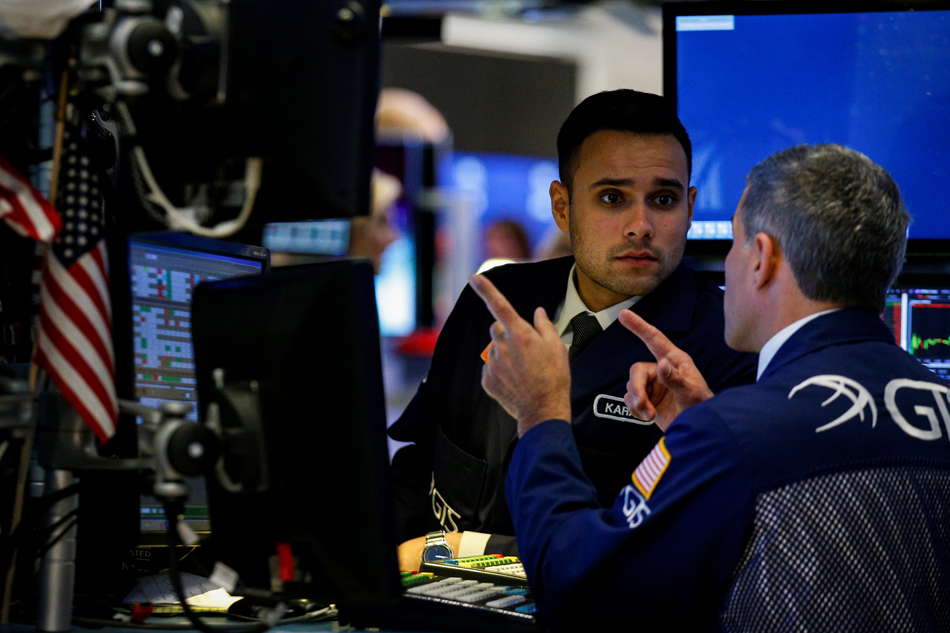
NEW YORK - World stock markets mostly rose Tuesday, with Wall Street scoring fresh records as concerns over North Korea and US hurricanes faded, but London dipped as strong inflation data sent the pound to a one-year dollar peak.
All three major US indices pushed to fresh records, with the S&P 500 notching a second straight peak, propelled by financial shares after bond yields rallied.
Frankfurt and Paris equities also gained as the North Korea crisis eased and dealers breathed a sigh of relief that Hurricane Irma caused less damage to Florida than initially feared.
"You've seen that fear unwind," said David Levy, portfolio manager at Republic Wealth Advisors.
Analysts also described relief that September, historically a weak month for stocks, has not so far produced a big pullback.
"Investors with a lot of cash have to put some money to work," Karl Haeling of LBBW. "They can't afford to miss more of the rally."
But London's benchmark FTSE 100 index was hobbled as official data showed Britain's 12-month inflation rate jumped to 2.9 percent in August compared to 2.6 percent in July.
In reaction, sterling jumped on hopes the Bank of England could lift its key interest rate sooner than expected, although it is not forecast to make any change at its policy meeting on Thursday.
Spreadex analyst Connor Campbell said that "sterling's FTSE-damaging rise prevented the UK index from indulging in the same North Korea and Hurricane Irma-related relief that lifted the US markets last night and is continuing to work its magic on the eurozone bourses."
"The effect has been to push the FTSE 100 into negative territory with London's main index stumbling, while across the channel eurozone stocks continue to find buyers," added Chris Beauchamp, chief market analyst at IG.
The British index finished down 0.2 percent.
Among individual companies, Apple dipped 0.4 percent after unveiling a group of new iPhones, including 10th anniversary iPhone X, featuring facial recognition unlocking and other refinements.
DowDuPont advanced 2.5 percent after confirming it was on target to save $4 billion following the completion of its merger. The chemicals giant also tweaked its plan to restructure into 3 companies to try to placate some shareholder activists who had criticized the original plan.
Eyes will now turn to the release of US inflation figures later in the week, which could provide some clues as to the Federal Reserve's plans for raising interest rates again this year. A weak run of data in recent months has led dealers to lower their expectations for any more tightening.
KEY FIGURES AROUD 2130 GMT (5:30 a.m. Wednesday in Manila)
New York - DOW: UP 0.3 percent at 22,118.86 (close)
New York - S&P 500: UP 0.3 percent at 2,496.48 (close)
New York - Nasdaq: UP 0.3 percent at 6,454.28 (close)
London - FTSE 100: DOWN 0.2 percent at 7,400.69 (close)
Frankfurt - DAX 30: UP 0.4 percent at 12,524.77 (close)
Paris - CAC 40: UP 0.6 percent at 5,209.01 (close)
EURO STOXX 50: UP 0.5 percent at 3,512.56 (close)
Tokyo - Nikkei 225: UP 1.2 percent at 19,776.62 (close)
Hong Kong - Hang Seng: UP 0.1 percent at 27,972.24 (close)
Shanghai - Composite: UP 0.1 percent at 3,379.49 (close)
Euro/dollar: UP at $1.1964 from $1.1954
Dollar/yen: UP at 110.18 from 109.44 yen
Pound/dollar: UP at $1.3280 from $1.3168
Oil - Brent North Sea: UP 43 cents at $54.27 per barrel
Oil - West Texas Intermediate: UP 16 cents at $48.23 per barrel
source: news.abs-cbn.com
Tuesday, September 12, 2017
S&P 500 chalks up record high as fear gives way
The S&P 500 surged over 1 percent to a record high close on Monday as tropical storm Irma caused less damage than expected in Florida, and after North Korea did not test-fire missiles over the weekend, which some had feared.
All 11 major S&P 500 sectors rose, led by financial stocks, with insurers advancing as Irma, once ranked as one of the most powerful hurricane recorded in the Atlantic, lost power.
Irma caused severe flooding in many Florida cities and left more than 6 million homes and businesses without power, but damage appeared to be less than expected. That relieved investors, especially in the wake of Hurricane Harvey, whose devastation is estimated to dent third-quarter economic growth.
Geopolitical tensions eased after North Korea did not mark its founding day on Saturday with another launch of a long-range missile, which the United States and its allies had been bracing for.
"It is a risk back on situation, people are going back into the market," said Neil Massa, senior equity trader at Manulife Asset Management in Boston. "For now, it is a relief rally for things on both ends - geopolitical and weather wise."
The Dow Jones Industrial Average rose 1.19 percent to end at 22,057.37 points in its largest one-day gain since February.
The S&P 500 gained 1.08 percent to 2,488.11 and the Nasdaq Composite added 1.13 percent to 6,432.26.
The CBOE volatility index, a widely-followed measure of market anxiety, fell 1.36 points to 10.76.
The S&P 500 financial index jumped 1.74 percent, with JPMorgan up 2.18 percent and insurer Travelers up 2.34 percent.
With investors less worried about Irma's impact, insurers Universal Insurance Holdings and HCI Group surged more than 12 percent, while Heritage Insurance soared 21 percent.
So far in 2017, the S&P 500 has risen 10 percent. It is trading near 17.6 times expected earnings, compared to its 10-year average of 14.3, according to Thomson Reuters Datastream.
"Valuations don't bother me terribly," said Tim Ghriskey, chief investment officer of Solaris Group in Bedford Hills, New York. "I don't think we're at a level where valuations themselves are going to cause a correction."
Apple rose 1.81 percent a day ahead of the expected launch of a new iPhone, providing the biggest boost to the Nasdaq and S&P 500.
Tesla jumped 5.91 percent on news that China was studying when to ban the production and sale of cars using traditional fuels.
Teva jumped 19 percent after the generic drugmaker named a new chief executive.
Advancing issues outnumbered declining ones on the NYSE by a 3.73-to-1 ratio; on Nasdaq, a 2.56-to-1 ratio favored advancers.
About 6 billion shares changed hands in US exchanges, above the 5.8 billion daily average over the last 20 sessions.
source: news.abs-cbn.com
Friday, October 28, 2016
US markets not fully buying a Clinton win
NEW YORK - As the US presidential election moves into the home stretch, financial markets are not fully invested in polls that show a win for Hillary Clinton.
Even though polls show the Democratic candidate with a strong lead over Republican Donald Trump, analysts say investors are waiting until after November 8 to lay their money on the table.
"I don't think it's fully 100 percent Clinton is in," said JJ Kinahan, chief market strategist at TD Ameritrade, who sees a pullback in risk-oriented investments as a sign of investor caution.
"Usually people are looking to take on extra risk for reward," he said. "I think this is one case where people are paring back on their risk."
Wall Street is thought to generally favor Clinton over Trump for president, and equity markets have hovered at historically high levels since July, with the S&P 500 less than three percent below its all-time peak.
Clinton is considered the more market-friendly outcome, expected to maintain the policies of outgoing President Barack Obama, while the market views Trump as a great unknown, both because of his penchant for controversy and his lack of a record in public office.
Trump has attacked trade partners China and Mexico and accused Federal Reserve Chair Janet Yellen of being a political tool of the Democratic party. Investors are also unsettled by Trump's seeming embrace of Russian President Vladimir Putin, a sign he may take foreign policy in radical new directions.
Signs of nervousness have been seen in certain trades, analysts say, like the Mexican peso. Trump's pledge of immigration controls and trade restrictions with Mexico have raised worries over its economy.
The peso sank against the dollar as Trump's campaign added momentum, but then rebounded on Clinton's gains following the first presidential debate on September 26.
But it remains down about 9 percent since Trump secured his party's nomination in May.
On the other hand, another gauge of market sentiment has been the biotechnology sector, which is seen as vulnerable in a Clinton presidency given the Democrat's vow to address runaway drug prices. The Nasdaq biotechnology index has fallen about nine percent over the last month.
Some analysts say the markets have already assumed a Clinton victory.
"To me, the markets clearly want a Clinton win and they have priced that in," said Nathan Thooft, senior managing director at Manulife Asset Management.
"That's what they predict, and that's what they want. If that doesn't happen, I feel there's a great level of uncertainty and possible downside to the markets."
SOME 'COMPLACENCY' OVER TRUMP
Indeed, investors are aware that Trump has been consistently underestimated by the political, media and business establishment. Many are also loath to repeat the error of Britain's June referendum to leave the European Union, when polling supported the market bet on a "stay" vote, only to be thrown into turmoil when Brexit passed.
"There's a bit of complacency in the market." said Kathy Lien of BK Asset Management,
"I think the market's underestimating the possibility of things going wrong as a result of either a Trump victory or the possibility of internal strife in the nation as a result of Clinton winning," she said.
Briefing.com analyst Patrick O'Hare cited sluggish trading volume, as well as the flatness of the S&P 500, as a sign investors are in "seeing is believing mode" with respect to polls pointing to a Clinton triumph.
One sign of a pickup in caution is the VIX volatility index, also known as the "fear" index. The index has risen the last three days and jumped nearly 8 percent Thursday to 15.36. Still, that is far below the 25.76 level on the day after the Brexit shock.
A big jump in the VIX before November 8 would signal "that the market is fearing something odd," Kinahan said.
source: www.abs-cbnnews.com
Subscribe to:
Posts (Atom)


