Showing posts with label Consumer Electronics Show. Show all posts

Friday, January 7, 2022

Change your car's color with an app: BMW unveils color-changing car

LAS VEGAS - German carmaker BMW has unveiled the world's first "color-changing" car at the Consumer Electronics Show (CES) in Las Vegas.

The concept car, called the BMW iX Flow, uses electronic ink technology normally found in e-readers to transform the car's exterior into a variety of patterns in gray and white.

"This is really energy efficient colour change using the technology E Ink," said BMW research engineer Stella Clarke. "So we took this material - it's kind of a thick paper - and our challenge was to get this on a 3D object like our cars."

When stimulated by electrical signals controlled by a phone app, the material brings different pigments to the surface, causing the car to take on a different shade or design, such as racing stripes.

In the future, the changes would also be controlled by a button on the car's dashboard or perhaps even by hand gestures, Clarke said.

No energy is needed to maintain the colour the driver selects, according to BMW.

"My favorite use case is the use of colour to influence sunlight reflections," said Clarke. "On a hot, sunny day like today, you could switch the colour white to reflect sunlight. On a cold day, you could switch it black to absorb the heat."

Though the vehicle displayed at CES could only alternate between gray and white, the technology will be expanded to cover a spectrum of colour, according to BMW. (Reporting by Omar Younis; Editing by Karishma Singh and Gerry Doyle)

-reuters-

Wednesday, January 8, 2020

'Sex tech' aims to rise above negative image


LAS VEGAS -- Sex toys are for relaxation. For education. For healing after childbirth. For long-term or long-distance relationships. For women's emancipation. 

And also... for pleasure. 

But manufacturers aiming for respectability tend to save this argument for last.

"Sex toys have an extremely negative connotation," said Jerome Bensimon, president of Satisfyer. "So we've rebranded ourselves as a 'sexual well-being company.'"

The company has gained attention for its pressure wave technology used for clitoral stimulation, and has plans to launch a smart phone app for controlling sex toys, in particular by using voice commands.

At its booth at the Consumer Electronics Show in Las Vegas, vibrators and Ben Wa balls sit alongside mini vibrators shaped like ice cream cones.

After some ups and downs, "sex tech" is testing the waters this year.

As recently as last year the display likely would have been banned.

At the 2019 show, the Consumer Technology Association, which runs the expo, stripped the Ose massager of an award for innovation, saying it was disqualified for being "immoral," "obscene" and "profane."

After an uproar, the CTA reversed itself and returned the prize to Lora DiCarlo, the company which manufactures the Ose.

Sex toys "are consumer electronics just like any other but are not treated like that," said Janet Lieberman-Lu, co-founder of Dame Products, which manufactures small devices for clitoral stimulation.

Given their widespread use, "sex toys are by definition mainstream.... They're more adopted than a lot of products at CES."

Her company has taken New York City's public transportation system to court, complaining that it allows advertisements for erectile dysfunction medications and ads that contain humorous references to sex -- but not for sex devices.

"When you say that male sexual function is healthy and necessary but vibrators for women are obscene, you're saying that men are supposed to be able to have sex and women aren't supposed to be able to enjoy it," said Lieberman-Lu.

"That's what leads to rape culture."

STARTING THE CONVERSATION

Entrepreneurs in this industry, many of whom started out in conventional consumer electronics, medicine or cosmetics, say pleasure and health go hand-in-hand.

Given that school textbooks only recently began including information on the shape and size of the clitoris, they say they are on a mission to educate the public.

It is often "much easier to talk about health than pure pleasure, which can involve fear of rejection," said Soumyadip Rakshit, CEO of Mystery Vibe, which develops vibrators that deal with both erectile difficulties in men and postpartum vaginal scarring in women.

To open up, people often need a catalyst. 

"Everyone is keen to talk about it but no one wants to be the first," he said.

"If someone does that for them, a company, an article, a doctor... it makes that so much easier."

Elsewhere on the showroom floor, Gerard Escaler, chief marketing officer at Lovense, explains how a male "masturbator" works.

The tubular objects have internal sleeves and are pink when intended for straight users and translucent for gay users.

The Hong Kong-based company offers several internet apps for use in long-distance relations -- with a partner or with online erotic performers like "cam girls" who sell access to live web video.

Lovense also is developing a virtual reality game for the male sex toy with female characters. Visitors have to imagine the contents, however, since the imagery, even if artificial, is not allowed during the consumer expo.

But the "sexual well-being" industry, which could swell to nearly $40 billion by 2024, according to a forecast from market research firm Aritzon, may have good reason to maintain an air of mystery and controversy.

Without the storm it created last year, the $300 Ose vibrator might not have taken off quite the way it did, said Lora Haddock DiCarlo, founder of the eponymous company which produces it.

"When we did our presale with Ose, after its long-awaited release at the end of November, we hit our yearly sales goal in five hours," she said, as she road aboard a transparent mobile showroom plying the streets of Las Vegas during the show.

The roving booth, like a fishbowl on wheels, displayed the catch phrase: "The pleasure is all yours."

Agence France-Presse

Friday, January 11, 2019

Retailers eye new tech, data to revive fortunes


LAS VEGAS -- With robots, augmented reality displays and other advanced technologies, traditional retailers are taking a cue from the online world to find new ways to connect and keep customers.


The 2019 Consumer Electronics Show in Las Vegas featured dozens of exhibitors showcasing how brick and mortar sellers can ramp up competition against the likes of Amazon and other online merchants -- and cope with what some call a retail apocalypse.

Chinese retail giants JD.com and Suning each had a large presence at the show in search of partners for their "retail as a service" strategy, to allow merchants to plug into new tech platforms.

"We believe the future of retail is not about online or offline, it's boundary-less," said JD communications manager Yuchuan Wang.

JD showed how retailers can use augmented reality screens that allow shoppers to use gesture control to virtually try on and buy clothing and beauty products.

With these systems, a retailer might not need to stock all apparel products in all sizes, enabling the consumer to simply click on an item in the store and have it delivered rapidly.

One of China's largest retailers, JD also showcased the use of delivery robots and drones which are being used in China, capable of reaching most Chinese consumers within a day or two.

SKIP THE CASHIER

Suning, which claims to be China's largest omni-channel retailer, also showed augmented reality retail try-ons as well as its cashier-free store similar to the Amazon Go model.

"I can pick up an apple and it tells me how much the price is," said Suning strategy director Watson Wat, who was showing CES attendees how its technology can be applied.

"And with my products I just walk out and it uses facial recognition to identify and charge me."

Suning announced it was seeking partnerships with retailers for its "brain of smart retail" that could enable stores to use its technology.

"I believe the technology is mature now, it's affordable," Wat said.

SMART MIRRORS

Elsewhere, Procter & Gamble's booth at CES showed how customers could use of augmented reality and facial recognition built into mirrors to get personalized recommendations for skin care and beauty products.

"We capture a unique identification for each person and deliver personalized results to them" on the basis of artificial intelligence, said P&G's Tina McCarthy.

SoftBank Robotics demonstrated how retailers can use two different kinds of robots -- one to interact with customers and another to monitor inventory and store shelves -- to help improve bottom lines.

SoftBank is partnering with Tally, made by Simbe Robotics, which scans store shelves to keep better track of what is available.

"There is a massive problem in the retail space between what the system says is on the shelf and what really is there," said Steve Carlin of SoftBank Robotics.

A more accurate system can help deal with merchandise which is overstocked or understocked, he added.

"We can start to push the right type of advertisements or incentives to shop the things that are over-inventoried," he said.

GETTING TO KNOW YOU

SoftBank's humanoid robot Pepper is teaming up on the effort by interacting with customers, including using facial recognition to greet customers by name and guide them to products.

"For retailers, they know a lot about you online but don't really know you at all in the store," Carlin said.

Offering suggestions in the same manner as online retailers can make sense.

"Retailers are always trying to get one more item in the basket," Carlin said. "They can't get more foot traffic but they are hoping to get more items in the basket."

Maeve Duska of the consultancy USA Technologies, said many retailers are stepping up efforts to keep up with the Amazon Go concept where customers can walk out and pay automatically without waiting for checkout, a concept known as "unattended retail."

"Finally the brick and mortar retailer understands how much competition there is from online," said Duska, who spoke at a CES panel on high-tech retailing.

"They are trying to duplicate the online experience."

With facial recognition to identify the customer and fingerprint and retina scans which can be used for payment, retailers are discovering ways to speed up the retail experience, often without interacting with a human. 

"We're very much a self-service society," she said.

For many younger shoppers, "they do not want to talk to people" in the store.

TEMPERED EXPECTATIONS

Analyst Brendan Witcher of Forrester Research, another CES panel participant, said some technologies like virtual and augmented reality can offer value for some goods that can help customers visualize clothing or other items.

But he cautioned against too much optimism about the use of data analytics and artificial intelligence to market in the manner of Amazon.

"Most retailers still can't get a personalized email out the door," he said.

"If that's the case it's not time to put a robot in the store.

source: news.abs-cbn.com

Thursday, January 10, 2019

Star Trek style translators step closer to reality at gadget show


LAS VEGAS -- Once confined to the realms of science fiction, near real-time translation devices that whisper discretely into your ear during a conversation are finally coming of age thanks to leaps in AI and cloud computing.

An array of companies at the Consumer Electronics Show are promoting increasingly sophisticated devices that allow people speaking different languages to converse with the help of handheld devices or wireless earpieces.

Waverly Lab's "Pilot" headphones translate 15 languages and are priced from $180 and $250.

If each person in a conversation is wearing a Pilot, they can speak directly to one another using their own language.

During a brief demonstration in Las Vegas, an AFP journalist speaking French was ably translated into the ears of English-speaking Andrew Ochoa, boss of Waverly Labs.

The company was founded in 2014 in New York. Translation work was routed to the cloud by Ochoa's smartphone, where an application can also create a written transcription of a conversation.

Computer power in online data centers interpret what is said, and send the appropriate translations to listeners taking part in conversations, Ochoa explained.

As a result, there could be lag of a few seconds to allow for interpretations.

MACHINE LEARNING

Universal translators have long been a fixture of science fiction, from shows like "Star Trek" to the babel fish that sits inside the ear canal and feeds off brain wave energy in "The Hitchhiker's Guide to the Galaxy."

But they have only recently become viable in the real world thanks to the increasing power and speed of mobile devices, machine learning, and wireless connections.

"We apply some features of AI, such as machine learning and neural network, to translation models," Ochoa said.

"Those technologies have matured enough to make this possible."

Software neural networks can be trained to understand phrases even if words are new to them, eliminating the need to feed entire dictionaries into systems.

Some 35,000 pairs of Pilot headphones have sold in less than a year, with customers including businesses such as hotels with keen need to engage customers speaking various languages, according to Ochoa.

China-based TimeKettle was at CES with WT2 earbuds that worked in a way similar to Pilot.

A Pocketalk device being shown off here by Japanese firm Sourcenext took smartphones out of the translation equation and hoped to be a hit during the Tokyo Olympics in 2020.

"We realized that, thinking about the 2020 Olympics, many Japanese only speak Japanese," said Sourcenext spokesman Richard Gallagher.

Pocketalk, which appeared reminiscent of an early-generation mobile phone, could translate 74 languages and was priced at $299, according to Gallagher.

"Thanks to machine learning, it progressively understands you better; your pronunciation," he said.

"It can adapt to the user."

Gallagher noted strong sales, with particularly heavy in retail, taxi, hotel or restaurant operations.

Chinese company iFlytex, a heavyweight in AI and voice recognition in Asia, presented a Translator 2.0 at the show capable of translating between Chinese and 30 other languages.

The latest Translator model was priced about $400.

Netherlands-based Travis laid claim to the first pocket-sized translation device infused with AI, and boasted having already sold 120,000 devices.

Internet giant Google meanwhile offers free translation software that ties up with its Pixel earbuds launched two years ago.

This week at CES, Google announced it was building translation capabilities into an array of new products through its virtual assistant software.

source: news.abs-cbn.com

Wednesday, January 9, 2019

For auto tech at CES, 'user experience' becomes the key


LAS VEGAS -- Technology firms tackling the challenge of autonomous driving are focusing on the "user experience" of vehicles that are increasingly becoming an extension of people's digital life.

Carmakers and tech firms are refining the systems for self-driving navigation and safety. But with full autonomy still likely years away, there is a growing interest in making cars a place to live, work, communicate and enjoy the ride.

At the Consumer Electronics Show this week, exhibitors were showcasing technology for comfort, safety, entertainment and personalization.

Byton, the China-based electric carmaker expected to launch its first vehicles late this year, showed its sedan with a 48-inch display panel, covering the width of the dash, where riders can watch movies, check messages and get other information -- although the full array of services won't be offered while someone is driving.

The Byton car will use facial recognition to customize the experience for drivers and passengers, with personalized music and recommendations.

The car would know who is inside and how long they have been traveling, and in one example cited by the company, make recommendations for restaurants along a particular route.

"The car could become the most important device in your digital life," said Carsten Breitfeld, co-founder and chief executive of Byton.

Byton will offer the potential for partial autonomy, allowing riders to focus on other things such as watching movies, shopping with a voice assistant or browsing the internet.

The vehicle will work through voice, touch, gestures or facial recognition.

"It's all about the customer experience," Carsten told a media event at the Las Vegas show, while noting that more of the enhanced features will be used when the car is in autonomous mode or stationary.

EMPATHY AND EMOTION

Gawain Morrison, co-founder of the British-based artificial intelligence startup Sensum, said the human factor was becoming more important in the automobile sector.

"A lot of the technology up to now has been about moving from point A to point B," he said.

"The next generation is about how to interact with the humans. They need an understanding about the human state at any point in the journey."

Sensum and its auto-supplier partner Valeo showed what it called "empathic mobility tech" which can measure occupants' emotional state and physiological comfort, and adjust its environmental settings accordingly.

The South Korean automaker Kia dubbed its system "'Real-time Emotion Adaptive Driving," or READ with an emotional AI-based cabin which analyzes a driver's emotional state by monitoring facial expressions, heart rate and electrodermal activity.

"The system enables continuous communication between driver and vehicle through the unspoken language of 'feeling', thereby providing an optimal, human-sense oriented space for the driver in real-time," said Albert Biermann, president and head of research for Kia parent Hyundai.

WARNINGS FOR DROWSINESS

German auto equipment maker Continental was showing its monitoring system which can detect if a driver is distracted or drowsy, in line with recommendations from the European Union.

"You may get a visual warning, or the seat will vibrate, or the steering wheel will vibrate," said Continental executive Heinz Abel. "This is part of an effort to guide your attention back to the road."

Several equipment makers were showcasing what they called the "cockpit of the future" which could be available for conventional vehicles and adapted for autonomous mode.

Visteon, a former Ford unit which makes automotive equipment, displayed its electronic control unit which integrates the driving and manages other system such as information and entertainment.

Upton Bowden, the head of new technology for Visteon, said equipment makers would be offering a "transitional cockpit" which helps people understand what is happening in autonomous mode.

"You want the occupants to trust the system," Bowden told AFP.

"When you get into an automated vehicle you have no knowledge of that system, so you have some level of discomfort."

The key to overcoming mistrust, he said, is to offer more transparency: "We can give you a real-time digital picture of what's going on by taking the data and transforming it into a graphical user experience."

Bowden said these systems could be especially useful for autonomous rideshare vehicles, allowing personalization of the experience through cloud-based technology.

"It would recognize who you were and handle payment through facial recognition," he said.

"It can instantly pair to your cloud account and bring in your favorite radio stations and other information."

source: news.abs-cbn.com

'High-tech,' meat-free burgers showcased in world's biggest technology fair


LAS VEGAS -- Can a "high-tech" burger help save the planet?

In one sense, it's just a patty made from plant protein. But the founders of California-based Impossible Foods argue the product can have a big impact by reducing the amount of land needed for beef and other livestock production.

Impossible Foods, which began in 2011, chose the Consumer Electronics Show in Las Vegas to launch its "next generation" burger -- version 2.0 -- which has no gluten, hormones or antibiotics and is kosher- and halal-certified.

With a handful of restaurateurs and chefs on hand, the company announced Monday it now has 5,000 restaurants serving its product as it prepares to begin selling in supermarkets.

Impossible Foods also brought a food truck to the large tech show to serve more than 12,000 samples of the burger to CES attendees.

Chief executive Pat Brown, a Stanford biochemistry professor and former pediatrician, said the decision to appear at CES was logical because the company is based on technology.

"To most consumers the face of the company is a food company but the soul of the company is really R&D (research and development) and technology," Brown told AFP ahead of a news conference at the Las Vegas tech extravaganza.

"What distinguishes us is we are developing a new technology platform that will transform the global food system."

The company, which has raised some $400 million, including from Microsoft founder Bill Gates, was launch to develop a plant-based product that simulates the taste and feel of beef.

It uses wheat protein, potato protein and coconut oil, and its "special ingredient" called heme which has elements of the hemoglobin in animal protein but is developed from soy.

Impossible Foods is among a handful of firms including California rival Beyond Meat developing plant-based or lab-grown meat substitutes that claim to offer products equal to or better than animal protect.

GLOBAL AMBITIONS

The Impossible Burger is served in several restaurant chains as well as the fast-food group White Castle, and is eyeing global expansion with restaurants in Hong Kong and Macau.

The company plans to launch the new recipe in Singapore within several months, with additional markets to come.

"We're doing some early work preparing for (global) expansion," Brown said.

Brown maintained that developing new kinds of protein is crucial for the environment when large areas of land -- some estimates suggest 40 percent or more of global land area -- are devoted to livestock.

Impossible Foods is "barely getting started" and hopes to be able to scale up to produce large quantities.

"Apple started with one hand-built computer," he said. "You have to start somewhere."

And he added that technology and research will help further improve the product.

"Unlike the cow we are going to be getting better every single day," he said.

source: news.abs-cbn.com

Tuesday, January 8, 2019

With rolling and folding displays, tech firms see good times ahead


LAS VEGAS -- Electronic displays that fold, roll and bend have finally arrived after years of development, and tech firms are touting the technology as a potential source of growth and new applications.

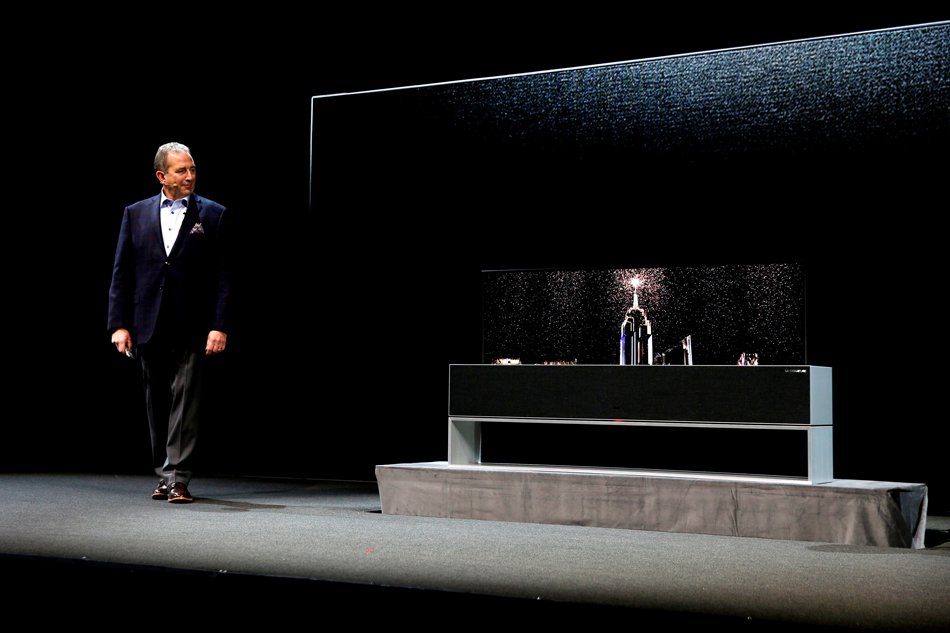
At the Consumer Electronics Show on Monday, South Korean giant LG unveiled its ultra-high definition television that rolls into and out of a base stand and can be furled and unfurled on demand.

"It brings freedom of design to a space, without the limitations of a wall," LG senior vice president of marketing David VanderWaal said while introducing the OLED TV R.

A demonstration showed that the 65-inch (165 centimeter) screen could disappear completely into the base, extend just part way to display photos, act as a control screen for smart devices, or rise completely for full viewing.

LG did not disclose pricing for the roll-up television.

Chinese startup Royole meanwhile showed off what it claimed is the first foldable smartphone, which can fit into a pocket but unfold into a full-sized tablet computer, which is available in China and now is offered in the US for $1,300.

"People want mobility but they also want large screens," Royole founder Bill Liu told a news conference as he showed the recently launched FlexPai device.

"It's really a combination of a smartphone and tablet."

Other device makers are expecting to introduce foldable handsets this year, but Liu said the technology using superthin layers with nano-sized sensors offered a lot more than just more convenient phones.

Royole showed how the same flexible displays could be used for automotive dashboards, wearables, and for various other commercial and industrial uses.

"We see this as the next generation of human-machine interface," Liu said.

"It can change the way we connect to everything."

Royole says its flexible sensor technology can be adapted for a variety of touchscreen applications with improved performance and lower costs than traditional screens.

COOL AND UNIQUE

Royole and LG were among the firms making media presentations ahead of the official opening of the January 8-11 Las Vegas event.

The two announcements could portend a wave of new products from tech firms this year and could offer a spark to a smartphone sector that has seen sluggish growth over the past year.

CES features 4,500 exhibitors across 2.75 million square feet (250,000 square meters) of exhibit space showcasing artificial intelligence, augmented and virtual reality, smart homes, smart cities, sports gadgets and other cutting-edge devices. Some 182,000 trade professionals are expected.

GlobalData research director Avi Greengart said the roll-up television appears "cool" and offers "unique technology."

"Foldable phones is going to be a big trend this year," Greengart said, noting that most of new product announcements of that ilk were likely to be saved for the upcoming Mobile World Congress in Barcelona.

Samsung is widely believed to launch a folding handset sometime this year, possibly at the Barcelona event.

Greengart said he expected the challenge to folding smartphones to be on the software side, not with the displays, since applications will have to be designed to adapt to going from phone to tablet screen sizes.

source: news.abs-cbn.com

Monday, January 7, 2019

Breadmaking robot startup eyes fresh connections


LAS VEGAS -- The robot breadmaker came to Las Vegas this week, aiming to bring some freshness to a sector that may be ready for disruption.

Wilkinson Baking Company unveiled its BreadBot at the Consumer Electronics Show, a machine that mixes and bakes up to 235 loaves a day.

BreadBot can lower costs and produce fresher breads than are available in most American supermarkets, chief executive Randall Wilkinson said.

"Consumers want the freshest thing possible, but when they go into the store they don't know when that bread was baked," said Wilkinson, a member of the family-owned firm in Walla Walla, Washington.

Wilkinson said the machine, which takes up as much room as a mid-sized car, has more automation technology than bread factories, and can produce at a far lower cost.

He noted that using in-store robotic machines could eliminate the need for truck delivery, which accounts for as much as 45 percent of the cost of most bread.

This means profits could get a rise.

The company is in talks with major supermarket chains and also plans to deliver the robots to the US military for making buns on carrier fleets, Wilkinson said.

The bread robot -- which was at a startup showcase Sunday and will be on the show floor from Tuesday -- joins a line of devices aimed at disrupting the food industry, including pizza-making robots and robotic baristas.

The current generation of BreadBot is designed for standard kinds of loaves but Wilkinson said the robots can be adapted for customized breads, even French baguettes.

"At some point you will be able to order a special loaf on your phone -- you can add sunflower seeds, use less salt or whatever -- and pick it up in an hour," he said.

source: news.abs-cbn.com

Gadget love forecast to grow in US despite trust issues


LAS VEGAS -- The trade group behind the Consumer Electronics Show set to start here Tuesday forecast that US gadget love will grow despite trust and privacy issues hammering the tech world.

The Consumer Technology Association (CTA) predicted that US retail revenue in the sector would climb to a record high $398 billion this year.

"There are so many cool things happening in the consumer electronics industry right now," said CTA vice president of market research Steve Koenig.

"We are fast approaching a new era of consumer technology."

Trends gaining momentum, and expected to be on display on the CES show floor, included super high resolution 8K televisions; blazingly-fast 5G wireless internet, and virtual aides such as Google Assistant and Amazon's Alexa woven into devices of all kinds.

The CTA forecast revenue growth in the US for smart phones, speakers, homes and watches along with televisions, drones, 'in-vehicle tech,' and streaming services.

Amid trade wars, geopolitical tensions and a decline in public trust, the technology sector is seeking to put its problems aside with CES, the annual extravaganza showcasing futuristic innovations.

The Jan. 8-11 Las Vegas trade event offers a glimpse into new products and services designed to make people's lives easier, fun and more productive, reaching across diverse sectors such as entertainment, health, transportation, agriculture and sports.

But the celebration of innovation will be mixed with concerns about public trust in new technology and other factors that could cool the growth of a sizzling economic sector.

"I think 2019 will be a year of trust-related challenges for the tech industry," said Bob O'Donnell of Technalysis Research.

CES features 4,500 exhibitors across 2.75 million square feet (250,000 square meters) of exhibit space showcasing artificial intelligence, augmented and virtual reality, smart homes, smart cities, sports gadgets and other cutting-edge devices. Some 182,000 trade professionals are expected.

source: news.abs-cbn.com

Wednesday, January 2, 2019

What to expect at CES 2019, world's largest technology fair


WASHINGTON -- Under the shadow of trade wars, geopolitical tensions and a decline in public trust, the technology sector is seeking to put its problems aside with the Consumer Electronics Show, the annual extravaganza showcasing futuristic innovations.

The Jan. 8 to 11 Las Vegas trade event offers a glimpse into new products and services designed to make people's lives easier, fun and more productive, reaching across diverse sectors such as entertainment, health, transportation, agriculture and sports.

"Smart" devices using various forms of artificial intelligence will again be a major focus at CES.

Visitors are likely to see more dazzling TV screens, intuitive robots, a range of voice-activated devices, and folding or roll-up smartphone displays. Also on display will be refinements to autonomous transportation and gadgets taking advantage of 5G, or fifth-generation wireless networks.

But the celebration of innovation will be mixed with concerns about public trust in new technology and other factors that could cool the growth of a sizzling economic sector.

"I think 2019 will be a year of trust-related challenges for the tech industry," said Bob O'Donnell of Technalysis Research.

CES features 4,500 exhibitors across 2.75 million square feet (250,000 square meters) of exhibit space showcasing artificial intelligence, augmented and virtual reality, smart homes, smart cities, sports gadgets and other cutting-edge devices. Some 182,000 trade professionals are expected.

MUCH ADO ABOUT DATA

There will be a focus on artificial intelligence that can "personalize" a user's experience with a device or a car, or even predict what someone is seeking -- whether it's music or medical care.

But because this ecosystem is built around data, confidence has been eroded by scandals involving Facebook, Google and other guardians of private information.

"The public is wary because of recent events," said Roger Kay, analyst and consultant with Endpoint Technologies Associates. "I think the industry will be slowed by this skepticism."

Carolina Milanesi, an analyst with Creative Strategies, said, "You'll definitely hear people talk about security more, and really looking at how you secure the data," at CES.

TRADE FRICTIONS

The Consumer Technology Association, which operates the show, acknowledges that the sector is being hurt by tariffs and trade frictions between the two largest economic players, the United States and China.

Tariffs on tech products jumped to $1.3 billion in October, according to CTA, raising fears about growth.

"It's almost inevitable that an economic slowdown will occur if these tariffs continue," said Sage Chandler, CTA vice president for international trade.

The US-China trade issues and the arrest of a top executive of Chinese giant Huawei in Canada have thrown into question the "supply chain," the system in which US designs are manufactured in China for the global market.

"This does cast a shadow over CES," O'Donnell said.

ARTIFICIAL INTELLIGENCE AND PERSONALIZATION

The auto sector will again have a major presence at CES with most major manufacturers on hand, some with prototypes of self-driving vehicles.

Japanese carmaker Honda will be showing an "autonomous work vehicle" which can be configured for search and rescue operations, firefighting and other uses.

Other exhibitors will be showing technology designed to serve as the "brains" of self-driving vehicles, not only for navigation but to create a better, more personalized "user experience" for travelers.

The show includes startups offering "predictive" health care solutions designed to anticipate the kind of care senior citizens may need.

Facial recognition, which is already being used on many smartphones, will be incorporated into vehicles, doorbells and security systems as part of efforts to increase personalization and improve security.

And consumer products group Procter & Gamble, making its first appearance at CES, will demonstrate ways to use facial recognition and AI for improved skin care and beauty recommendations.

The new applications raise questions on whether consumers are ready for technologies that evoke the notion of Big Brother and a surveillance state.

Brenda Leong, senior counsel at the Future of Privacy Forum, a Washington think tank, said consumers should be mindful about whether data from facial recognition is kept only on the devices, such as in the iPhone, or held in a database.

"Even if commercial institutions are collecting the data, everybody is worried about government access," she said.

Patrick Moorhead of Moor Insights & Strategy said consumers have shown a willingness to adopt these new technologies if they offer convenience.

"If they are balanced from a benefit point of view, those worries are going to go away," he said.

Moorhead noted that as facial recognition has become a standard feature for many smartphones, "those fears have faded."

O'Donnell said consumers are starting to understand more about data and become more discerning about which companies and devices they trust.

"Personalization is something people want, and they are willing to give up some privacy to get it," he said.

"But if they can get personalization on the device without sending it to the cloud, they get the benefits without giving up privacy."

source: news.abs-cbn.com

Friday, January 12, 2018

Beyond the car: how tech firms are exploring the future of transport


LAS VEGAS - Carless commuting is cruising in the fast lane at the Consumer Electronics Show, with companies showing off electric bicycles, scooters, skateboards and more aimed at making the internal combustion engine a thing of the past.

As the ranks of people around the world living in cities has grown, so too has the cost of car ownership as well as traffic congestion.

Nowhere was this more apparent than at the annual tech gathering in Las Vegas where some 170,000 conference goers jammed the streets.

"In a lot of big cities, cars aren't tenable anymore," said tech analyst Jack Gold of J. Gold Associates.

An AFP reporter testing the car-free concept through the week at CES by relying on a freshly released GenZe electric bicycle consistently sailed past clogged traffic near the convention center and on the famed Las Vegas Strip.

Riders too tired or lazy to pedal meanwhile can twist a throttle to glide along at close to local street speed limits.

GenZe spokesman Tom Valasek, a former auto industry marketing executive, said that several car makers had come to check out the company's CES exhibit.

"There is a lot of curiosity right now about where things are heading," Valasek told AFP.

"I know a lot of people in the auto industry who are quite worried that car ownership is going away."

DRIVERLESS CARS 

The popularity of smartphone-summoned rides from services such as Uber and Lyft are playing into the trend, with technology giants investing heavily in self-driving capabilities that could soon see automated vehicles available on-demand.

"We believe car ownership makes no sense in the future," Lyft chief executive John Zimmer said at a CES dinner event.

Zimmer doubted that his daughter, now a young child, will want to own a car when she is of age. Instead, he said: "She'll want access to transportation."

A boom of autonomous cars would likely prompt vehicles to evolve to be more akin to rooms on wheels: sleeper cabins in trains, or private offices, Zimmer added.

A shift away from owning and relying on cars was also expected to result in traffic and parking becoming less of a priority in urban design.

GenZe, a US-based division of the Mahindra Group in India, this week announced its e-bikes will be added in April to a Ford GoBike ride-share program in San Francisco.

The e-bikes should "help to make San Francisco more livable and reduce congestion," Metropolitan Transportation Commission deputy executive Alix Bockelman said in a release.

Leading online social network Facebook has a fleet of 100 GenZe bikes for employees to get around its Silicon Valley campus, and they are also used by delivery services DoorDash and Postmates, according to Valasek.

SCOOT, SKATE, RIDE
  

Despite negative publicity about hoverboards a few years ago -- centered on their tendency to explode -- the manufacturer Swagtron was at CES with some of those devices along with skateboards and bicycles boosted with electric motors.

"We are seeing with personal mobility that some people like to skate; some people like to scoot, and some people like to ride," Swagtron chief operating officer Andrew Koven told AFP.

Koven saw alternatives to cars as an "absolute necessity" that was part of a "systemic shift" toward getting around in ways that are economical as well as socially and environmentally responsible.

"If I am commuting a short distance to work, do I really need a car?" analyst Gold asked rhetorically.

Cities are already eyeing autonomous shuttle services.

A self-driving electric shuttle built by Navya was introduced here last year in a test that segued into a program providing rides on a route in downtown Las Vegas.

Swiss-based Rinspeed also showed its autonomous shuttle, and Toyota introduced a boxy concept vehicle which could be used for ridesharing, deliveries, medical services or as an extension of retail stores.

Plenty of new cars were shown at CES including a number of self-driving models. But some attendees said that the vehicle of the future may be something different.

Automakers "have been building cars from the driver's perspective," said Ankit Jain, head of the Ola Play software platform for the India-based rideshare group.

In future vehicles which may be autonomous, "the passenger is the one paying," Jain said. "You have to fundamentally rethink the car."

source: news.abs-cbn.com

Thursday, January 11, 2018

Old dog, new tricks: Sony unleashes 'intelligent' robot pet


TOKYO - As Japan celebrates the year of the dog, electronics giant Sony on Thursday unleashed its new robot canine companion, packed with artificial intelligence and internet connectivity.

The sleek ivory-white puppy-sized "aibo" robot shook its head and wagged its tail as if waking from a nap when it was taken out of a cocoon-shaped case at a "birthday ceremony" held in Tokyo.

Seven-year-old boy Naohiro Sugimoto from Tokyo was among the first to get his hands on the shiny new toy, which he described as "heavy but cute".

"The dog we had previously died... We bought this robot dog as we wanted a (new) family," he said.

The 30-centimeter (one-foot) long hound-like machine comes complete with flapping ears and its eyes, made of a cutting-edge light-emitting display, can show various emotions.

Aibo is also fitted with an array of sensors, cameras and microphones and boasts internet connectivity.

The owner can play with the pet remotely via smartphone and even teach it tricks from the office for the faithful hound to perform when its "master" gets home.

It builds up a "character" by interacting with people and while not always submissive, it is friendly towards those who are kind to it.

What the machine "learns" is stored in the cloud so its "character" can be preserved even in the event of hardware damage.

Photos it takes can also be shared.

But such cutting-edge canine technology does not come cheap, with the aibo costing nearly $3,000 for a three-year package, including software services such as data storage.

TOUCHES A CHORD  


Aibo is not the Japanese electronic giant's first foray into the animal robot entertainment world.

Its earlier robot dog was put to sleep more a decade ago -- a victim of business restructuring -- shocking fans.

Sony rolled out the first-generation dog in June 1999, with the initial batch of 3,000 selling out in just 20 minutes, despite a hefty price tag of 250,000 yen ($2,200 at current rates).

Over the following years, more than 150,000 units were sold, with numerous models ranging from gleaming metallic-silver versions to round-faced cub-like models.

But by 2006, Sony was in trouble. Its business model was under pressure and it was facing fierce competition from rivals in all fields.

The robot dog, an expensive and somewhat frivolous luxury, had to go.

Yasuyuki Nakamura, another owner of the new generation Aibo -- his third robot pet -- said he was happy to see the dog back in Sony's catalog.

"I had been waiting (for a new aibo). I ordered one as I was happy to see this kind of business was revived," the 46-year-old said.

A middle-aged couple said they bought the robot for their 25th anniversary this year.

Sony plans to release the new aibo overseas as well but no details are set yet.

The dog does not speak human languages or perform tasks such as turning a light on.

But that is not the point of the product, according to Sony's Izumi Kawanishi who is in charge of the project.

"You don't think about what the dog can do when you want to get a dog, do you?," he asked reporters.

"The point is that it touches a chord (with people)," he said.

source: news.abs-cbn.com

Monday, January 9, 2017

Virtual assistants and robots: 2017 CES highlights


LAS VEGAS - Here are some key highlights of the 2017 International Consumer Electronics Show, which concluded Sunday:

ALEXA EVERYWHERE

Amazon's virtual assistant Alexa was the surprise star of the show, with dozens of new products and services integrating the voice-accessed machine smarts into appliances, TVs, speakers, lamps, cars and more.

Analysts said the gains for Alexa could help unify a fragmented market for connected devices, and bring artificial intelligence to more people, from young to old.

ROBOTS WITH CHARACTER

Robots showed off new skills and "personality." Hanson Robotics unveiled its life-like "Professor Einstein," which has realistic facial expressions and can engage in informative conversations such as lessons in math and science.

Other robots acquired intelligence from the internet cloud, giving them the ability to chat person-style and tend to monitoring homes or other tasks. A robot from Taiwan played chess -- moving pieces against human opponents -- to showcase how able it was at making sense of what it "sees."

CARS GET MORE AUTONOMY (AND FASTER)

The secretive electric car startup Faraday Future, backed by a Chinese billion, showed its first production car, the FF91, aimed at taking on Tesla. The company showed how fast it can accelerate -- getting to 60 mph (100 kph) in 2.39 seconds -- and began taking pre-orders for 2018.

The other major car-makers were not idling, instead showcasing moves toward autonomous driving, electric power, and better connections -- including integrating with smart home systems.

THINNER, SMARTER TVS

LG Electronics showed off a "wallpaper" thin television, while rivals Sony and Samsung unveiled technology for more realistic displays. A push was on to entice people with 4K ultra-rich screens.

Sales of televisions globally have been slipping, a seeming result of viewers turning to smartphones, tablets, and computers for video, according to the US Consumer Technology Association trade group behind CES.

Those who do buy televisions, however, are expected to prefer high-definition models.

SMARTPHONES NOT DISAPPEARING

CES featured a surprising number of smartphone launches, including one from Taiwan's Asus that can use Google's Project Tango 3D technology and virtual and augmented reality.

This came as the industry prepared to mark the 10th anniversary of the launch of the iPhone on January 9 and with some participants noting that much of the industry revolves around the smartphone.

New mid-range handsets were unveiled by South Korea's LG, China's ZTE and Huawei, which also revealed its ambition for a greater share of the US market by launching its flagship large-screen handset.

VIRTUAL REALITY

While not appearing ready for prime time, virtual reality sought its stride at the show.

Show floor space devoted to virtual reality abounded with companies diving into the market with headsets, content, or tools for better creating or delivering immersive experiences.

Taiwan-based HTC announced initiatives aimed at getting developers to create more VR experiences and unveiled plans for arcades in public venues so more people could give it a try.

Vive is up against PlayStation VR and Facebook-owned Oculus Rift. Each company has been wooing software developers and refining its hardware to better entice users.

BETTER BODIES


Emerging technologies for fitness, health and improving life for the handicapped flourished, including those harnessing brainwaves for the physically disabled; helping the visually impaired with "artificial vision," and getting insightful data on sports endeavors.

BrainRobotics, a Massachusetts-based startup, showed its prosthesis that can be controlled by residual muscle strength of an amputee with better efficiency than similar devices, and which may eventually be controlled by brainwaves.

HOVERBOARDS ARE BACK

Those quirky skateboard-like personal transporters made it back to CES, a year after most disappeared due to a federal raid of devices with potentially explosive batteries.

Hoverboard Technologies founder Robert Bigler unveiled his single-wheeled GeoBlade, proclaiming it to be the future of personal urban transport, and Swagtron released its "off-road" hoverboard.

source: news.abs-cbn.com

Smartphone revolution blazes on as iPhone turns 10


LAS VEGAS -- The smartphone continues to change the world a decade after the debut of the iPhone, even as Apple is under pressure to come up with a new wonder.

The iPhone -- introduced by late Apple co-founder Steve Jobs on January 9, 2007 -- set the stage for mobile computing and an entire industry revolving around it.

The handsets built on successful iPod digital music players and featured touch screens at a time when the smartphone market was ruled by BlackBerry devices with keypads.

Jobs billed his smartphone approach as blending liberal arts, design and technology.

What was not obvious at the time was how iPhone's focus on apps would send people rocketing along a path to tweeting, Snapping, Pokemon Go, live streaming video, and more.

"Apple gets credit for the apps that brought the mobile computing platform to your pocket," Gartner analyst Brian Blau told AFP at the Consumer Electronics Show that ends Sunday in Las Vegas. "Today, it is hard to make a consumer electronics product without (internet) connectivity."

Smartphones are even playing a big role in the virtual reality trend, with people using handsets as screens inserted into headsets for exploring fantasy realms.

Apple does not attend CES. But its trend-setting power is felt here from cars boasting "infotainment" systems that synch with iPhones, to smart-home networks controlled by mobile apps and rival smartphones mirroring iPhone features.

"The iPhone changed the world because mobile computing is now part of everyone's daily life," Blau said.

Altered landscape


The iPhone, in a way, was a seed around which the consumer electronics industry has crystalized, according to Maxwell Ramsey of mobile phone news website phoneArena.com.

"It's pretty remarkable what it did," Maxwell said of the iPhone. "We are still riding that wave from 2007. No doubt about it."

Putting the internet in people's pockets, and on tablet computers, has profoundly changed the way people watch films, get news, socialize and work.

Insiders at the CES trade show cited the iPhone as the main impetus for the revolutionary shift to mobile computing lifestyles.

"It turned the industry on its head," Maxwell said at CES. "It figuratively destroyed a lot of companies, and changed the landscape."

The iPhone powered Apple's money-making machine, but sales began to decline last year in the increasingly saturated and competitive smartphone market.

Missed targets


Apple chief executive Tim Cook and other top executives saw their compensation for 2016 cut because internal income targets were missed, according to a filing Friday with US regulators.

"The two financial measures used to evaluate executive performance under our annual cash incentive program, net sales and operating income, declined from our record-breaking 2015 levels," Apple said in the filing.

"These results were below the target performance goals."

Apple reported net sales of $215.6 billion for the fiscal year, with an operating income of $60 billion, the filing indicated.

Cook's pay will tally $8.75 million as compared with $10.3 million in 2015. His base pay jumped to $3 million from $2 million.

Apple's profit in the quarter ending September 24 slumped on a widely expected drop in iPhone sales, but gains in services offered optimism on company efforts to curb dependence on its smartphone.

Apple is to release performance figures for the recently ended quarter on January 31.

Apple has been working to make more money from services and apps.

The iPhone maker said its App Store had its busiest single day ever on New Year's Day, capping a record-breaking holiday season for the online shop.

Since the App Store launched in 2008, developers have earned more than $60 billion from software creations tailored for Apple devices, according to the company.

Meanwhile, eyes are on Apple for its next "big thing" in the face of worry that the company lost its innovative mojo with the passing of Jobs in 2011.

Rumors of projects in the works include a self-driving car.

"I think they will have a next big thing," analyst Blau said. "But the future of the company will rely on smaller innovation. And there is nothing wrong with that kind of a business."

source: news.abs-cbn.com

Thursday, January 5, 2017

'Wallpaper' thin TV grabs spotlight at CES gadget gala


LAS VEGAS - LG Electronics showed off a "wallpaper" thin television as TV makers vied for the spotlight ahead of the Consumer Electronics Show officially opening here on Thursday.

As in years past, the South Korean consumer electronics giant staked out the opening slot in a day rich with back-to-back press briefings by industry titans.

LG and rivals touched on hot themes at this year's show -- including robots, appliances equipped with artificial intelligence, and self-driving car technology.

A surprise star of the presentation was a strikingly thin LG Signature OLED flat-screen television simply branded "W."

The super high-definition TV measured just 2.57 mm thick in a 65-inch screen model. LG boasted that a larger screen model garnered a CES Best of Innovation Award.

"Why the 'W'?" LG Electronics USA marketing vice president David VanderWaal asked rhetorically during the presentation.

"Wallpaper. Window. Wow," he said.

The screens are designed to affix to walls with magnetic brackets, protruding less than 4 mm.

TCL OUT TO GROW

China's fast-growing television-maker TCL was at the show with a mission to expand its market.

TCL unveiled 25 new Roku-enabled TV models heading for North America, boasting improved high-definition imagery and enhanced audio.

"We are here today because we are investing in the future of technology, specifically smart TVs," TCL marketing executive Ranjit Gopi said during a press briefing.

"We are, as of 2016, one of the fastest growing brands in the world."

TCL partners include internet titan Google and its Android TV offering.

TCL is investing some $7.7 billion in high-quality television screens and is aiming to make the world's slimmest curved television, according to Gopi.

He introduced a new flagship "X" series television that will launch first in China and then be rolled out elsewhere.

South Korean consumer electronics giant Samsung unveiled a new 75-inch QLED TV model at its CES press gathering, along with a company-first gaming laptop.

"Despite some challenges, we've made big strides in 2016, gaining market share in TVs, home appliances, wearables and smartphones," said Samsung Electronics America chief operating officer Tim Baxter.

"We are delivering on our vision of the future – one that is powered by connected and elegantly-designed products and services that put consumers firmly at the center."

EYE-GRABBING SCREENS

Samsung ramped up its smart TV platform with an offering tailored for sports lovers, and added a new entertainment application. Features in the new models included being able to recognize who is speaking while being commanded by voice.

Sales of televisions globally have been slipping, a seeming result of viewers turning to smartphones, tablets, and computers for video, according to Steve Koenig, senior director of market research at the US Consumer Technology Association trade group behind CES.

Koenig forecast that $105 billion will be spent this year on televisions, down from $108 billion last year.

However, those who do buy televisions are expected to prefer 4K high-definition models, with the number of those screens sold jumping to nearly 82 million this year compared with just shy of 53 million last year, according to Koenig.

source: news.abs-cbn.com

Sunday, January 10, 2016

Battle for digital life takes center stage at tech show


LAS VEGAS -- The battle to be at the center of your digital life has taken on a new dimension amid a proliferation of connected devices.

After smartphone wars, browser wars and platform wars, a fight is on to be the "hub" which connects the millions of connected objects from light bulbs to wearable to washing machines.

At the Consumer Electronics Show which concluded Saturday, the contenders included robots, televisions, speaker hubs and even wearable trackers powered by artificial intelligence. And the connected car raced into the mix.

Exhibitors ranging from startups to big consumer electronics giants are vying to be the control center for the vast array of Internet of things in your home, car, and elsewhere.

South Korea's LG unveiled its Smart ThinQ home hub, a speaker that lets a user communicate with and get alerts from connected appliances, security systems and even talk to cars.

This allows the smart home and connected car to communicate with each other. And it can connect with older appliances with attachable sensors.

LG calls this "the future of the smart home" and uses an open platform that can connect with devices using Google Nest, Bluetooth, Wi-Fi and more.

Samsung announced its TVs will act as command centers in smart homes by incorporating technology from Silicon Valley start-up SmartThings, which Samsung bought in 2014, allowing them to control devices synced to the platform.

"You can have a smart home basically for free as a starting point; it is pretty amazing," SmartThings founder and chief Alexander Hawkinson told AFP.

Chinese electronics giant Haier unveiled its Ubot personal assistant robot -- a near-humanoid gadget which can control home appliances.

"He's like a personal assistant who can turn on your TV and all your appliances, and when you're not home he helps with surveillance," said Haier's Kristen Smith. "The ultimate goal is to simplify your life, to take care of the things you worry about."

Respond and entertain


Segway, which is owned by China's Ninebot, unveiled a personal transporter which morphs into a cute robotic personal assistant.

The robot, made in collaboration with Intel and China's Xiaomi, is open to developers which could add on applications for security, entertainment or other activities.

After riding it, the device sprouts arms and can navigate and interact with users with its sensors and artificial intelligence. It is expected to be commercialized later this year.

More whimsical, Chinese startup UBTech Robotics unveiled Alpha 2, a prototype personal assistant humanoid which can respond and entertain.

"You can talk to him and he will answer. He can give you the weather," said UBTech's Jessica Pan. "And he is very lifelike. He has 20 joints and can move like humans, he can dance and show you a yoga pose."

These new contenders face a tough battle against entrenched companies like Google and Apple -- not part of the floor exhibitors at CES -- which each have their own artificial intelligence assistants as well as ecosystems for connected homes and wearables.

And Facebook's Mark Zuckerberg said ahead of the show that he wants to build a robot butler "like Jarvis in 'Iron Man'" which can manage household tasks.

While Zuckerberg and Facebook were not exhibiting at CES, his comments and the innovations at the show underscore the progress being made in computing and artificial intelligence which can unleash new innovations.

Wearable Siri

Israeli-based startup OrCam, for example, unveiled a wearable artificial intelligence clip-on camera which "acts like a personal assistant like Siri or Cortana, but with eyes and ears," says OrCam marketing chief Eliav Rodman.

The device "can provide a real-time profile of people as they walk up to you during a conference, displaying their details on your smartphone or watch; it can track your eating habits," says OrCam co-founder Amnon Shashua.

"It can even monitor the facial expressions of people you meet and topics of discussion and let you know in hindsight the quality of interaction you have with friends and family."

Carmakers don't want to be left out either.

Ford, for example, unveiled an alliance at CES with US online giant Amazon aimed at allowing people to connect their cars into "smart home" networks.

The tie-up will enable drivers to communicate with the hub and, for example, ask if their garage door is open, or request an appointment with their mechanic.

Other carmakers including BMW and Volkswagen showed systems which connect not only to a smartphone but to home networks, enabling users to tap smart appliances or garage door openers, for example.

Wild West

These new systems offer new connecting options but could create confusion because of multiple technical standards.

"It almost forces you to get things within the same brand in order to match up," said Ron Montoya at the auto research firm Edmunds.com.

Roger Kay, analyst at Endpoint Technologies Associates, agreed, saying that There is no grand architecture, so everyone is making a land grab. Everyone wants to be the hub."

Kay said that until players such as Apple, Google and Microsoft agree on open standards, "it going to be difficult for this market to move forward."

source: www.abs-cbnnews.com

8 takeaways from 2016 Consumer Electronics Show


LAS VEGAS -- Here are some key highlights from the 2016 Consumer Electronics Show, which concluded Saturday:

1. Netflix stunned the show with the announcement that it added 130 new countries for its streaming TV service to bring its total to 190, calling it "the birth of a new global Internet TV network."

India will be one of the new markets for Netflix, which is still studying ways to get into China.

2. Google and Lenovo announced plans to produce the first consumer handset using the US computing giant's Project Tango 3D technology.

The device set to launch worldwide later this year aims for a new generation of smart devices that can be used for indoor mapping, augmented reality and more.

3. The 4K high-definition television format became the standard base for manufacturers, which showcased thinner and more spectacular displays for those willing to pay the price.

The Consumer Technology Association, the trade group behind CES, said one in every five televisions sold this year is expected to be 50 inches or more, measured diagonally, and feature ultra high-definition 4K resolution.

4. The Internet of Things showed spectacular growth from products like a smart mirror from Haier that delivers news and weather and connects to other appliances, and connected spoons and diet scales.

Samsung unveiled a smart refrigerator that lets its owner use a smartphone to virtually peer inside and see what should be on a shopping list.

5. Wearable technology probed deeper to get more data about health, while making inroads into the medical field: diagnosing conditions and even offering treatment for pain and other ailments. Shoes measured steps and shirts kept tabs on heart rates.

French-based health group VisioMed introduced its Bewell Connect "virtual checkup" through a smartphone app that communicates with its connected blood pressure and glucose monitor, thermometer and blood oxygen sensor.

6. Automakers moved to connect not only to the smartphone, but to the smart home and other parts of the digital life.

Ford teamed with Amazon to link up the carmaker's Sync vehicle hub with the online giant's smart home hub called Echo.

7. Virtual reality spread beyond video games to touch sex, sports, sales and space exploration. Facebook-owned Oculus began taking pre-orders for its eagerly-anticipated Rift VR headsets at a price of $599, and CES was rife with companies scrambling to field competing devices or content that could draw people into faux worlds.

8. Startups turned attention to ways to tap into the brain.

A "mind control" headband unveiled by startup BrainCo effectively hacks into brain signals with a range of possible applications -- from helping to improve attention spans, to detecting disease, controlling smart home appliances or even a prosthetic device.

source: www.abs-cbnnews.com

Friday, January 8, 2016

New wave in tech: hacking the brain


LAS VEGAS, United States - The next frontier for the tech sector is the human brain.

A new breed of neuro-hacker is finding ways to capture and manipulate brainwaves to improve health, with potential to help the severely handicapped.

A number of the innovations were on display at the Consumer Electronics Show in Las Vegas, where computer scientists and biomedical experts showcased ways to tap into and use brain signals.

The "mind control" headband unveiled by startup BrainCo effectively hacks into brain signals with a range of possible applications -- from helping to improve attention spans, to detecting disease, controlling smart home appliances or even a prosthetic device.

The device "translates your brainwaves into electronic signals," said the Boston-based firm's Zenchuan Lei.

At CES, BrainCo demonstrated how a person could use the headband to manipulate a prosthetic hand -- a potential life-changer for those paralyzed or missing limbs.

"These signals can be used to control objects like a prosthetic hand," Lei said. "You can turn the lights on or off just by focusing on that."

The device designed by scientists from Harvard and the Massachusetts Institute of Technology employs "neuro feedback," a means of allowing people to control their brain waves for various purposes. It is expected to be sold later this year for less than $150.

Lei suggested the device could also help people with attention deficit hyperactivity disorder because "it teaches you to enhance your focus and concentration."

A similar project on display from New York-based OpenBCI (which stands for open-source brain-computer interface) seeks to create a platform for applications of the technology in health care, education or other fields.

OpenBCI uses a 3D-printed helmet which captures brainwaves from various sectors of the brain.

- 'Neuro-marketing' potential -

"This can be used to help people with ALS (amyotrophic lateral sclerosis or Lou Gehrig's disease) or quadriplegics communicate," said OpenBCI chief executive Conor Russomanno.

The technology also offers a potential for so-called "neuro-marketing" which tests new products and services on the basis of sensory and cognitive response.

South Korean startup Looxid Labs unveiled a headset that tracks both brainwaves and eye movements, claiming this provides more accurate insights into the mind.

"No other device that I'm aware of combines these things," said Looxid chief business officer Alex Chang.

With the headset attached to a computer, "you can roll your eyes to scroll the mouse, and click on a button by blinking," Chang said.

The headset is being launched in July as a developer kit, with scope to build applications for controlling physical or virtual objects, communicating, analyzing a user's mood or mental health, or verifying their identity.

"We also see this as having potential in gaming because you can control things with your eye," Chang said.

"When you concentrate you can stop the bullets."

He added that for neuro-marketing applications, "we can show someone an ad and we can see where the eyes are focused. We can scan emotions and understand how someone is responding."

Other exhibitors at CES demonstrated wearable devices that block pain signals to the brain, as an alternative to medications with side effects for people who suffer from debilitating pain.

- Meditation aid -

The neuro-feedback technique is being applied as a meditation aid by Canadian-based Interaxon and its Muse headband.

Muse uses sensors on the forehead and behind the ears to measure brain signals, and advise users how to improve their meditation technique.

The coaching app helps people achieve a level of consistency in their meditation efforts.

"It's like going to the gym. The muscle doesn't get stronger unless you do it over and over again. It's the same with your brain," said Muse marketing manager Tracy Newsom-Rosenthal at the CES show.

One startup at CES was showcasing a technique to deliver pleasure signals to the brain via music, by triggering the release of neurotransmitters such as dopamine, serotonin and oxytocin.

The hand-held device from Florida-based Nervana allows users to plug in a music player into the $299 device and get the pleasurable signals delivered by its headphones.

"We send a signal into the vagus nerve which produces dopamine, and that relaxes you," CEO Ami Brannon told AFP on the show floor.

"Some people describe the sensation as euphoric."

But Brannon said the technique "is not really hacking the brain."

"We access the central nervous system and it just tickles the nerve to remind the brain to release dopamine," she said.

"People who practice yoga or meditation can already do this."

source: www.abs-cbnnews.com